How to Read a Crane Load Chart Before You Book the Lift
In this article
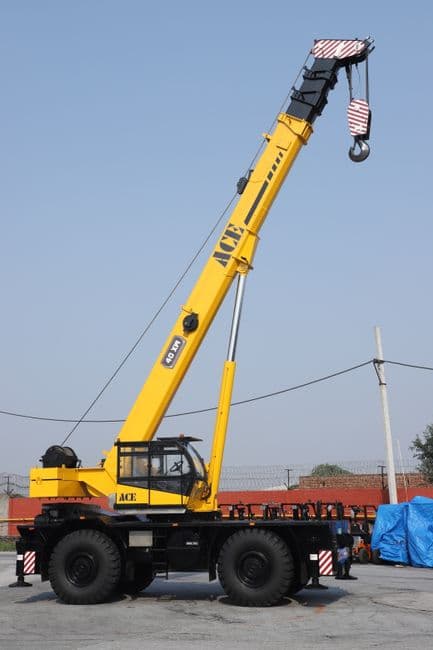
A mobile crane rated at 25 tonnes arrives at a site in 6th of October City to set four precast stair flights onto a podium slab. The heaviest flight weighs a little over 4 tonnes. On paper the margin looks absurd. Then the crane is set up, and the only standing position that clears the boundary wall and the site accommodation puts the load 17 metres away from the crane. At that radius, on the boom length the job needs, the chart gives a rated capacity below the weight of the flight. The lift is refused, the precast sits on the trailer, and someone spends the afternoon on the phone.
Nothing was wrong with the crane. The wrong question was asked at booking, and the answer was only discovered on site. Reading a crane load chart — even roughly, even as a non-operator — is the single cheapest way to stop that afternoon from happening.
A crane's name is its best-case number
When a crane is described as a 25-tonne, 50-tonne or 100-tonne machine, that figure is its maximum rated capacity under a very specific set of conditions: the shortest boom, the minimum working radius, the full counterweight fitted, the outriggers fully extended, firm and level ground, and the load lifted over the strongest quadrant of the machine.
Almost no real lift on an Egyptian site meets all six conditions at once. The rated capacity is a headline, not a promise, and it falls away steeply as the load moves out from the machine: a crane that lifts its name-plate figure right beside itself may handle only a fraction of that at the far end of a working radius. That is not a defect. It is how every crane behaves, and it is exactly what the chart exists to describe.
Radius is measured from the centre of rotation
The most common site error is measuring the radius from the wrong place. The radius is the horizontal distance from the crane's centre of rotation — the centre of the slewing ring, not the cab, not the front bumper, not the boom foot — to the centre of gravity of the suspended load.
Three refinements that matter more than they sound:
- Measure the radius with the load hanging, not with the boom unloaded. The boom deflects under load and the radius grows.
- The governing radius is the worst point in the whole operation, not the pick point. If the crane picks at 9 metres and places at 17, the lift is a 17-metre lift.
- Every metre of extra standing distance forced by a fence, a stockpile or an excavation edge is a real reduction in capacity. Clearing an obstruction so the crane can stand two metres closer is often worth more than upgrading a crane class.
The four inputs the chart wants from you
A load chart is not one table. It is a book of tables, and picking the right page is most of the work.
- Configuration — counterweight fitted, outrigger extension (full, intermediate, or retracted), boom or boom-plus-jib. Each combination is its own page.
- Boom length — usually the columns.
- Radius — usually the rows.
- Quadrant of operation — over the rear, over the side, or a full 360-degree rating.
Here is what you are actually looking at once you have the right page:
| Element on the chart | What it means for your lift |
|---|---|
| Page heading (counterweight, outrigger spread) | The exact machine configuration the numbers apply to. If the site cannot accommodate that configuration, the page is wrong. |
| Row values, in metres | Working radius from the centre of rotation |
| Column values, in metres | Main boom length |
| The figure in the cell | Gross capacity, before any deduction |
| Shading, bold text or a stepped line | The point where the limit changes from machine strength to stability |
| Footnotes and general notes | Deductions, wind limits, permitted quadrants, definitions — routinely the most important text on the page |
Gross capacity is not what you can hang on the hook
The number in the cell includes everything suspended from the boom. Before you compare it with your load, subtract:
- The hook block and the weight of the hoist rope reeved out
- Slings, chains, shackles, and any lifting beam, spreader or frame
- A jib, even when it is stowed and folded along the side of the boom
- An auxiliary sheave head, hook ball, or any secondary hoist arrangement
- Anything else hanging: tag lines with weights, load-turning devices, a man-basket if one is rigged
What remains is the net capacity available for the load itself. Then check the load's weight from a source you trust. Quoted weights are frequently nominal catalogue figures while the real object is heavier: a tank with residual water in it, a bucket that still has soil in it, a skid with its transport frame attached. On a lift close to the chart, the gap between a documented weight and an assumed one is the whole safety margin.
Two different limits are hiding in the same table
At short radii, the rated load is set by the strength of the machine — the boom sections, the hoist ropes, the cylinders, the slew ring. At long radii it is set by stability: how close the crane is to tipping over its outriggers or tracks. Load charts are derived from a margin below the tipping load, and the exact margin depends on the standard the crane was rated to.
Do not rely on movement, operator feel or an alarm to warn of an approaching overload. Follow the exact applicable chart and lift plan within their limits; structural or stability failure may occur without a useful warning. A previous successful lift does not establish that the current configuration is safe.
The ground under the outriggers is the other half of the chart
Every figure on the chart assumes the crane is standing firm and level. On Egyptian sites, that assumption is often the weakest part of the whole plan: uncompacted backfill over a recently closed trench, loose sand around a villa plot, made ground on a reclaimed parcel, a canal or drain edge, a service duct, or a basement slab that was never designed for a point load of this kind.
Two things follow:
- Ask the rental provider for the outrigger reaction loads for the configuration you intend to use. A single outrigger can carry a very large share of the combined weight of crane, counterweight and load, concentrated on a small pad.
- Size the mats or pads against the bearing capacity of the ground you actually have — from the geotechnical report if the project has one, and from the structural engineer if the crane will stand over any structure, podium, basement or buried service.
Partial outrigger extension deserves its own warning. It is not a proportional reduction that you can estimate. It is a different page of the chart, with its own numbers, and on some machines the reduction over the side is dramatic. If the site only allows the outriggers half out on one side, that must be known before the crane is dispatched, not after it arrives — and it changes which crane you should have booked. That is the same planning discipline that governs getting the machine to site in the first place, where counterweight often travels separately and access width decides everything.
Check the rating for every working quadrant
Quadrant ratings depend on the crane and its configuration. Check the manufacturer’s chart across the entire planned slew path; do not assume that the side or rear is always the strongest direction.
Plan the whole arc, not the two end points. If the crane must travel the load through a weak quadrant, the weakest position on that arc governs the lift.
What the chart does not tell you
- Wind. Ratings assume operation below a stated wind limit. Large, light loads — cladding panels, formwork, empty tanks, sheeting — have a sail area far out of proportion to their weight, and for them wind, not tonnage, is the governing constraint. Plan spring khamaseen days and windy coastal or desert afternoons as lifting risks, not weather trivia.
- Dynamics. Snatching a load, swinging it, or braking a slew hard adds forces that the static chart figure does not cover.
- Duty-cycle work. Dragging, grabbing, pulling sideways or freeing a stuck load is not lifting, and no cell in the chart authorises it.
- Multi-crane lifts. Two cranes sharing a load is an engineered operation with its own plan and its own reduced ratings, not two charts read side by side.
The pre-lift pack that gets you the right crane
Most refused lifts trace back to a booking made with three pieces of information instead of eight. Before asking for a crane, put together:
- The heaviest load's weight and dimensions, with the source of the weight stated
- The pick position and the set position, so the radius can be established
- The required height under hook: lift height, plus load height, plus rigging height, plus clearance
- Any obstruction the load must clear — a wall, a scaffold, a completed structure, a live building
- A description of the standing ground, and any structure, basement or buried service beneath it
- Access route width, gate width, and turning space for the crane and any support vehicles
- The number of lifts, the working window, and whether night work is involved
- Overhead power lines or any other proximity hazard
With that pack, a fleet can propose a crane class and configuration that will actually work, rather than sending the tonnage that sounds right. It is also the information that turns a vague enquiry into a firm quotation — you can browse available crane classes and send the details when you request a project quote.
If you are still deciding between machine types rather than sizing one, the comparison in tower crane versus mobile crane covers that decision first; load-chart work comes after it.
Five minutes, before the trailer moves
Reading a load chart properly is the operator's and the lift supervisor's responsibility, and nothing here replaces a competent appointed person or an engineered lift plan. But a site engineer who can find the right page, read the radius row and subtract the rigging will catch the expensive mistakes days early — the 17-metre radius nobody measured, the jib nobody deducted, the outriggers that were never going to fit.
That is a five-minute habit with the same value as a whole day of site time, and it is the difference between a crane that arrives and lifts, and a crane that arrives, sets up, and goes home.
Sources and scope
Each source supports the topic described below, not every statement in this article. Foreign guidance does not replace Egyptian requirements or site rules. Use the manual matching the machine model and serial number for operation.
- HSE — Planning lifting operations
Competent lift planning and supervision. UK guidance, not a statement of Egyptian law.
- Manitowoc — Crane technical library
Manufacturer chart/manual lookup; obtain the document matching the exact crane and configuration.
Need a machine for your site?
Browse EXON's maintained fleet or talk to the team for a project quote.
Keep reading
Equipment Rental Hours and the Hour Meter: Timesheets, Standby and the 208-Hour Month
How equipment rental hours are counted in Egypt: the hour meter, daily timesheets, standby and breakdown hours, the 208-hour month and overtime.
Tower Crane Installation: Foundation, Erection, Climbing and Dismantling, and Where the Time Goes
Tower crane installation step by step: base design, anchors and curing, erection by mobile crane, load test, climbing, and planning the dismantle from day one.
Construction Logistics on Egypt's North Coast: Water, Wind, Machines and the Summer Season
Construction logistics on the North Coast of Egypt: bringing machines in, water by tanker, wind and salt, fuel, and planning around the summer season.