Excavator Production per Hour: How to Work Out Cubic Metres and Trucks
In this article
Take a 6,000 m³ basement in hard clay and a 1 m³ bucket. On paper the excavator finishes in about six working days. With five trucks instead of eight, the same machine takes about ten, and nothing about the excavator has changed. Both answers come from the same short calculation, and most programme arguments on an excavation site come from skipping it.
This guide shows how to work out excavator production per hour: the formula, the three factors that cut the headline number down, which cubic metre you are actually counting, and how to check the result on site with a stopwatch.
The factors below come from the US Army's earthmoving field manual, FM 5-434, an openly published reference that gives the whole method. It is an American reference with averages for common materials, not an Egyptian specification, and it says so itself: where the exact figure matters, test the material. Use it to plan, then correct it with your own site's numbers.
The formula in one line
Hourly output is the number of bucket cycles in an hour multiplied by what each cycle really carries:
Loose m³ per hour = (3,600 ÷ cycle time in seconds) × heaped bucket capacity × fill factor × (working minutes ÷ 60)
To turn that into the volume on your drawings, one more step:
Bank m³ per hour = loose m³ per hour × load factor
Each term has a job.
- Cycle time covers one full round: fill the bucket, swing loaded, dump, swing back. The manual's average is 14 seconds for buckets under about 0.76 m³ and 15 seconds from there up to about 1.9 m³. Those averages assume a cut at 40 to 60% of the machine's maximum digging depth and a swing of 30° to 60°. Dig deeper or swing wider and the cycle gets longer.
- Heaped bucket capacity is the rated figure on the spec sheet for the bucket actually fitted to the machine, not the one in the brochure.
- Fill factor is how much of that heaped capacity the material really gives you.
- Working minutes allow for everything that isn't digging. The manual's standard assumption is 50 working minutes in the hour, a factor of 0.83.
- Load factor converts loosened material back to its volume in the ground.
Fill factor and swell, by material
The two factors that change most from site to site both depend on the ground, so read them from the soil report before you read them from a table.
| Material | Fill factor (hoe bucket) | Swell | Load factor |
|---|---|---|---|
| Moist loam or sandy clay | 100 to 110% | about 25% (wet earth) | 0.80 |
| Sand and gravel | 95 to 110% | 10 to 15% | 0.87 to 0.91 |
| Hard, tough clay | 80 to 90% | 40% | 0.72 |
| Well-blasted rock | 60 to 75% | about 50% (trap rock) | 0.66 |
| Poorly blasted rock | 40 to 50% | not given separately | not given separately |
Swell means that 1 m³ of dry clay in the ground fills 1.4 m³ once it is dug. The load factor is the same fact the other way round: 1 ÷ 1.4 gives about 0.72, so 1 m³ in the truck was only 0.72 m³ in the ground.
A worked example: 1 m³ bucket, 15-second cycle
Here is hard clay, step by step, with a 1 m³ heaped bucket.
- Cycles per hour: 3,600 ÷ 15 = 240.
- Ideal output: 240 × 1 m³ × 0.85 = 204 loose m³ per hour.
- With a 50-minute hour: 204 × 50 ÷ 60 = 170 loose m³ per hour.
- In the ground: 170 × 0.72 = about 122 bank m³ per hour.
Run the same machine through the table and the material does the rest:
| Material | Fill factor used | Loose m³/h | Load factor used | Bank m³/h |
|---|---|---|---|---|
| Sand and gravel | 1.00 | 200 | 0.89 | 178 |
| Moist loam or sandy clay | 1.05 | 210 | 0.80 | 168 |
| Hard clay | 0.85 | 170 | 0.72 | 122 |
| Well-blasted rock | 0.68 | 136 | 0.66 | 90 |
These are illustrative calculations, not benchmarks, and they hold the cycle at 15 seconds to keep the comparison clean. Rock will rarely hold that pace, and solid rock is a different job altogether: it needs breaking first, which is covered in excavator with breaker hire.
Which cubic metre are you counting?
Most disputes over earthworks quantities are really about this. The drawings and the survey measure bank volume. The truck carries loose volume. Count truckloads and you get a bigger number than the hole.
Take 100 loads in a 16 m³ body. That is 1,600 loose m³. In hard clay it is about 1,150 m³ in the ground. In sand it is about 1,420 m³. If you pay a subcontractor per cubic metre, or a tip per load, write down which cubic metre the price refers to and how it is measured. A survey before and after is the cleanest answer; a load count needs an agreed swell factor.
Weight is the other trap. Using the manual's average loose weights, a 16 m³ body of wet clay comes to roughly 23 to 28 tonnes, and dry sand to roughly 25 to 28 tonnes. On heavy material the truck can reach its rated payload before the body looks full, so check the payload rather than loading to the top.
The truck is usually the limit
An excavator that loads trucks directly can only dig as fast as trucks arrive. Stay with the hard clay example and a 16 m³ body:
- Each load takes about 19 passes: 16 ÷ (1 × 0.85).
- Nineteen passes at 15 seconds is nearly 5 minutes of cycling, close to 6 once the truck has swapped in.
- At 170 loose m³ per hour, the excavator can fill about 10.6 trucks an hour.
If the round trip, including loading, is 45 minutes, you need 45 ÷ 5.6, or about eight trucks. With five trucks you dispatch fewer than seven loads an hour, about 107 loose m³, which is 77 bank m³. For the 6,000 m³ basement, working eight hours a day, that is the gap from the opening of this article: around 6 days against around 10.
The full truck-count method is in foundation excavation: machines, trucks and the order of work. What matters here is that trucks can be the harder thing to find. In the Facebook equipment groups, as of 23 September 2026, there were 33 requests for every 100 dump trucks listed, against 19 for excavators, on the market pressure table. Those are counts of posts, not orders, but they are a reason to confirm the trucks before you fix the dig dates.
What moves the number on site
Four of the manual's points cost nothing and show up directly in the cycle.
- Dig at the right depth. The best digging is at 30 to 60% of the machine's maximum depth. A bench that keeps the bucket in that range beats a machine reaching from the top.
- Keep the swing short. Spot trucks so the machine never turns more than 90°.
- Put the truck on the pit floor if you can. With the truck level with the machine, the bucket doesn't have to lift again before swinging. The manual puts the saving at about 12% of the cycle.
- Keep the working area level and smooth. That means a loader or dozer on the site roads and the pit floor, not an excavator tidying up between trucks.
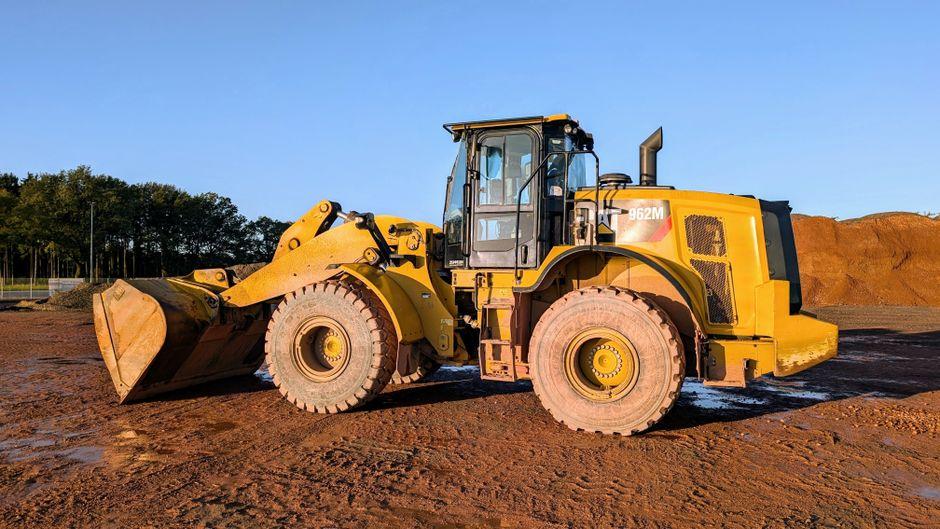
If you dig to a stockpile and load later, a wheel loader takes over the loading. The manual gives an average cycle of 0.45 to 0.50 minutes for loaders from about 0.76 to 2.9 m³ with no extra travel, and fill factors of 0.80 to 1.00 for soil. Run the same formula with those figures before deciding, and wheel loader rental becomes a question you can price.
Time the machine, then trust your own number
Tables get you a plan. A stopwatch gets you the truth. On the first day, time 20 full cycles at normal pace, and count trucks and loads for a full shift.
The cycle alone can move the result a long way. If the hard clay example runs at 22 seconds instead of 15, output falls from about 122 to about 84 bank m³ per hour, a loss of nearly a third. A check that takes half an hour can change a programme by weeks.
Then carry that figure into the two other sums that matter:
- Fuel per cubic metre. Divide fuel burned per hour by real output, using the figures in how much fuel heavy machines burn per hour. A slow cycle costs twice: more hours and more fuel per metre.
- Hours paid against hours digging. Compare your output with the hours on the meter and the timesheet, as set out in how rental hours are counted. A machine waiting for trucks may still be on the clock, depending on your contract.
The quick version
- Get the bucket size from the spec sheet and the material from the soil report.
- Calculate loose m³ per hour, then bank m³ per hour.
- Divide the job's bank volume by the bank output to get working hours.
- Work out the trucks that output needs, and confirm you can get them.
- Agree in writing which cubic metre you are paying for.
- Time the machine on day one and redo the sums.
Next step
Once you know the bucket size and truck count your job needs, you can browse excavator rental and request a quote, or message us on WhatsApp with the volume, the soil and the dates.
Sources and scope
Each source supports the topic described below, not every statement in this article. Foreign guidance does not replace Egyptian requirements or site rules. Use the manual matching the machine model and serial number for operation.
- US Army FM 5-434 — Earthmoving Operations (15 June 2000)
Hydraulic excavator and wheel loader production estimates, bucket fill factors, cycle times, and material swell and load factors. Averages from a US field manual, not an Egyptian specification or a measured output for any site.
- EXON Radar — Egypt heavy-equipment market analytics
Aggregate counts from public Facebook equipment groups, snapshot dated 23 Sep 2026; asking prices, not sale prices.
Need a machine for your site?
Browse EXON's maintained fleet or talk to the team for a project quote.
Keep reading
Sling Angle Load Calculation: How Much Each Leg Really Carries
Sling angle load calculation for site lifts: why a 4-tonne load can put 4 tonnes on each leg, the L ÷ H method, worked examples and when to retire a sling.
Excavation Slope Angle by Soil Type: How Far Back to Cut the Sides
Excavation slope angle by soil type: 53°, 45° and 34° from the OSHA table, how to work out the top width and extra volume, and when to support the sides.
Crane Outrigger Pad Size: Working Out Ground Pressure Before the Lift
Crane outrigger pad size explained: outrigger load ÷ pad area = ground pressure, worked examples in kN/m² and kg/cm², who checks the ground and what to send.