Flatbed vs Lowbed Trailer, and Where the Tipper Fits: Which Trailer for Which Load
In this article
A contractor in Sadat City has three things to move this week: a 20-tonne tracked excavator from the previous job, two containers of reinforcing steel from the supplier, and several hundred cubic metres of fill to raise the plot. On the phone, all three start with the same word: "I need a trailer." Three very different vehicles answer to that word, and sending the wrong one costs a lost day at best and a damaged machine or a stopped convoy at worst.
This guide sets out the flatbed vs lowbed trailer question, and where the tipper fits beside them: what each one is built to carry, why deck height is the number that matters for machines, how each one is loaded, and what the transporter needs from you before they quote.
Three vehicles, three jobs
Flatbed (سطحة). A flat deck at the height of the trailer chassis, with no drop and no body. It carries anything that can be lifted on and strapped down: steel, pipes, blocks on pallets, containers, generators, compressors, site cabins and smaller machines. It is the general-purpose vehicle of site logistics.
Lowbed (لوبد). A trailer whose deck drops down between the gooseneck at the front and the axles at the rear, so the load sits much closer to the road. That lower deck is the whole point: it keeps a tall machine within the height the route allows, and it makes it possible to drive a tracked or wheeled machine on up ramps. Excavators, dozers, large loaders, rollers and graders normally travel on a lowbed.
Tipper (قلاب). A truck or semi-trailer with a body that tips to empty itself. It carries loose material, not machines: excavated spoil, sand, gravel, aggregate, broken concrete and fill. It is loaded by an excavator or a loader and empties itself where it is told, which is why a tipper fleet sets the pace of any dig.
| Load | Usual vehicle | Why |
|---|---|---|
| Tracked excavator, 20 t class and above | Lowbed | Overall height and the need to drive on |
| Dozer, grader, roller, large wheel loader | Lowbed | Weight, width and height together |
| Mini excavator, skid-steer | Light flatbed or plant trailer with ramps | Small enough for a normal deck |
| Telehandler, forklift | Flatbed (drive-on with ramps or lifted on) | Boom or mast lowered and locked |
| Generator, compressor, lighting tower, cabin | Flatbed | Lifted on by crane or forklift |
| Steel, pipes, blocks, containers | Flatbed | Flat deck, many tie-down points |
| Spoil, sand, gravel, fill, broken concrete | Tipper | Loose material that has to be dumped |
Why deck height is the number that decides machine moves
The height that matters on a road is not the machine's height. It is deck height plus machine height, measured to the highest point that travels: cab roof, exhaust stack, folded boom, rops frame or mast. The same excavator on a flatbed and on a lowbed is two different loads as far as a bridge, an underpass or an overhead cable is concerned.
Deck heights also differ between lowbed designs. A trailer with a deep, short well sits lower than one with a long, flat low deck, and some lowbeds carry the excavator's arm in a recess at the rear. So ask the transporter for the deck height of the trailer they will actually send, not the type in general, and add it to the machine's transport height from its specification sheet.
Then check the route, not just the vehicle: bridges and underpasses, overhead power and telephone lines, toll gates, and the gates and internal roads at both ends. The full planning sequence for a move, including permits for oversize loads, is in moving heavy equipment between sites in Egypt.
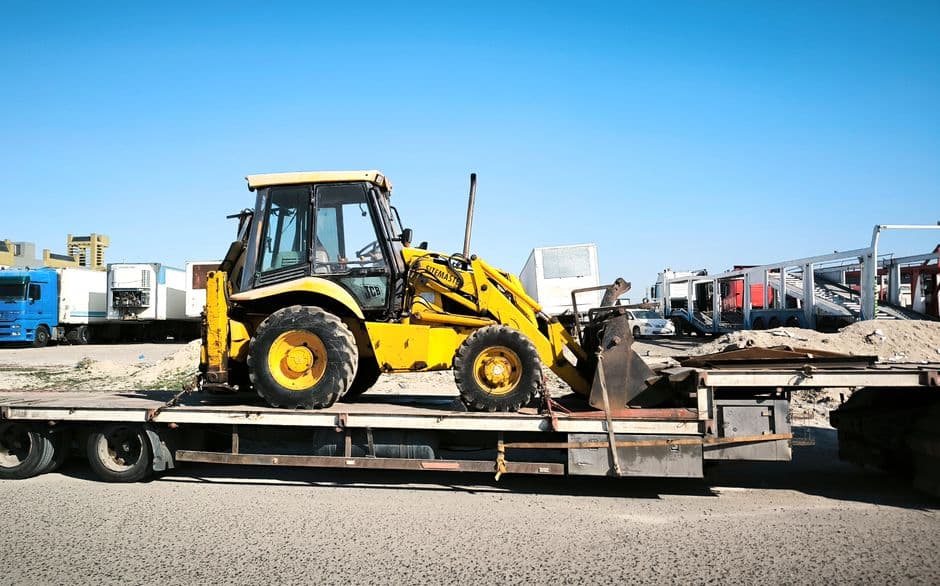
Borderline machines: flatbed or lowbed?
Backhoe loaders, small and mid-size wheel loaders, and excavators in the 12 to 15 tonne range sit on the line. Whether one of them can go on a flatbed comes down to three checks. First, its transport height on that flatbed against the lowest point on the route. Second, its transport weight against the flatbed's rated payload and axle loads. Third, a safe way to get it onto the deck: ramps rated for its weight, or a crane. If any of the three fails, it goes on a lowbed. A transporter who offers a flatbed for a mid-size machine should be able to tell you the overall height of the loaded vehicle; if they cannot, ask for a lowbed.
How each one is loaded
Lowbed. Most lowbeds load from the rear over ramps. The machine drives up under its own power, guided by a signaller, at slow speed and in a straight line. Some heavy-haul lowbeds have a detachable gooseneck: the front drops to the ground and the machine drives on from the front, which suits low machines that cannot climb a steep ramp. Either way, the ground under the trailer has to be firm and level, because a trailer that settles on one side while a machine is on the ramps is how machines fall.
Flatbed. A flatbed is usually loaded by lifting: a crane, a forklift or a telehandler. Driving a machine onto a flatbed needs ramps rated for its weight, and the steeper angle makes it a job for a machine that is small and light. Containers need a crane or a container handler, and their corner fittings must be locked to the trailer's twist-locks.
Tipper. Loaded from the side or rear by an excavator or a loader. The loading machine has to reach over the side of the body, so check its dump height against the height of the body side the haulier will send. A small excavator often cannot load a high-sided tipper cleanly.
Tippers: volume, weight and supply
Tippers are quoted by body volume in cubic metres, but the body can be full by weight before it is full by volume. Wet sand, broken rock and broken concrete are heavy, and a body loaded to the brim with them can be over the truck's legal payload. Agree with the haulier how a load is counted (per trip, per cubic metre, per tonne) and how it is checked, before the first truck arrives.
Tippers are also harder to source than most machines. In EXON's analysis of Egypt's public Facebook equipment groups, dump trucks drew 33 requests for every 100 listings, the highest of any machine class shown, as of 23 September 2026 (market demand data). These are posts, not confirmed orders, but the direction is clear: book your trucks early, and plan the excavator's daily output around the number of trucks you can actually get. The relationship between the digger and the trucks is covered in foundation excavation: machines, trucks and the order of work.
Never use a tipper to carry a machine. The body is not built for point loads from tracks, it has no proper tie-down points, and the tipping gear is not a lift.
Securing a machine on the deck
Egypt has its own traffic rules for heavy loads, and the transporter is responsible for meeting them. As a reference for what good securing looks like, the US federal rule for carrying heavy vehicles, equipment and machinery (49 CFR 393.130) sets out a clear minimum:
- Attachments such as buckets, blades and booms are lowered completely to the deck and secured.
- Articulated machines, such as wheel loaders, are restrained so they cannot articulate in transit; use the frame lock.
- The machine is restrained against movement forward, backward, sideways and upward.
- At least four tie-downs, attached as close as practicable to the front and rear of the machine, or to the tie-down points the manufacturer provides.
In practice that means chains and binders in good condition, attached to the machine's marked tie-down points rather than to the bucket teeth or hydraulic lines, and checked again after the first few kilometres. The UK safety regulator's guidance on loading and unloading adds the site side: a firm, level area away from traffic and overhead lines, a competent operator, one signaller, and nobody standing between the machine and the trailer while it moves.
Mistakes that cost a day
- Ordering by the word, not the numbers. "A trailer for an excavator" is not a booking. The transporter needs the model, the transport weight and the dimensions.
- Forgetting the attachments. A breaker, a wide bucket or a counterweight may travel separately. Count them in the load.
- Assuming the drop site is ready. The lowbed needs room to turn and stop, and firm ground to unload. A long vehicle that cannot enter the gate unloads on the road.
- Ignoring the return. Mobilisation and demobilisation are two moves. Agree both, and who pays for each, in the rental contract.
- Sending a flatbed for a machine that needs a lowbed because it was available that day. Wait for the right vehicle.
What to tell the transporter
- The machine's make and model, and its transport weight with the attachments it will carry.
- Transport length, width and height from the specification sheet.
- Pick-up and drop-off locations, with a pin, and the times each site can receive a long vehicle.
- The access at both ends: gate width, internal roads, ground, overhead lines.
- How it will be loaded and unloaded: driven on, lifted on, or by crane, and who supplies the operator.
- For tippers: the material, the estimated volume, where it goes, and how loads are counted.
Next step
When you know what you are moving and the numbers above are on paper, browse the trailer rental page to see what is available and request a quote, or message us on WhatsApp with the load and both locations.
Sources and scope
Each source supports the topic described below, not every statement in this article. Foreign guidance does not replace Egyptian requirements or site rules. Use the manual matching the machine model and serial number for operation.
- 49 CFR 393.130 — Securing heavy vehicles, equipment and machinery (US federal rule)
Attachments lowered and secured, articulation prevented, restraint in every direction and at least four tie-downs near the front and rear. A US rule used as a reference for good practice, not Egyptian law.
- HSE — Loading and unloading
Safe loading/unloading arrangements. Route permits need local confirmation.
- EXON Radar — Egypt heavy-equipment market analytics
Aggregate counts from public Facebook equipment groups, snapshot dated 23 Sep 2026; asking prices, not sale prices.
Need a machine for your site?
Browse EXON's maintained fleet or talk to the team for a project quote.
Keep reading
Mini Excavator for Villa Foundations and Utility Trenches: What It Can and Cannot Do
A mini excavator for villa foundations and service trenches: size classes, dig depth and width, gate and ground checks, buried services, and when you need a bigger machine.
Tractor Horsepower for Farm Work: Sizing a Tractor for Ploughing, Levelling, Trailers and Pumps
What tractor horsepower farm work really needs: PTO vs drawbar power, field speed, feddans per hour and fuel per feddan for ploughing, levelling and pumps.
Compressor CFM for a Jackhammer, Sandblasting or Spraying: The Numbers in Plain Terms
What compressor CFM a jackhammer, a sandblasting nozzle or a sprayer needs, in bar, l/s and m³/min, from manufacturer charts, plus the hose and nozzle traps.