Tractor Horsepower for Farm Work: Sizing a Tractor for Ploughing, Levelling, Trailers and Pumps
In this article
A grower in Beheira has 20 feddans of heavy clay to plough before wheat goes in, and a lessor offers "a 75-horse tractor". Is that enough for a three-furrow plough? The honest answer is that 75 is probably the engine figure, and in the field only about half to two-thirds of the tractor's PTO power ever reaches the drawbar. Whether the job takes two days or four depends on that gap, on the soil and on the width of the implement, not on the number painted on the bonnet.
This guide explains tractor horsepower for farm work in practical terms: which power figure matters for each job, how to check that a tractor and an implement are matched, how many feddans an hour to expect, and how much fuel to plan for. It covers ploughing and tillage, land levelling, trailers and PTO-driven pumps.
Three horsepower figures on one tractor
Every tractor has three power figures, and they are not interchangeable:
| Figure | Where it is measured | What it drives |
|---|---|---|
| Engine power | At the engine flywheel | Nothing directly; it is the headline number |
| PTO power | At the rear power take-off shaft | Rotary tillers, mowers, pumps, sprayers |
| Drawbar power | At the hitch, while pulling | Ploughs, chisels, discs, levellers, trailers |
PTO power is lower than engine power because some power is lost in the transmission. Drawbar power is lower again, and it depends heavily on the ground. Extension engineers at Virginia Tech, Rutgers and the University of Vermont put it plainly: normally only 50% to 65% of the maximum PTO horsepower is converted to drawbar horsepower in the field. The rest goes into wheel slip, rolling resistance and moving the tractor's own weight.
So a tractor with 75 PTO horsepower (about 56 kW) delivers roughly 38 to 49 horsepower at the drawbar in a field. If the quote says 75 horsepower and it is the engine figure, the drawbar figure is lower still. Before comparing tractors, ask which of the three numbers you are being quoted.
Match the power path to the job
The first question is not "how many horses" but "does the job pull, or does it spin a shaft?"
| Job | Power path | What sets the size |
|---|---|---|
| Ploughing: mouldboard, chisel, disc | Drawbar | Soil, depth, working width, speed |
| Rotary tiller | PTO, plus some pull | Width, depth, the tiller's rated PTO range |
| Laser levelling with a scraper bucket | Drawbar and hydraulics | Bucket width, soil moved, traction |
| Trailers on farm tracks | Drawbar and brakes | Loaded mass, braking, hitch rating |
| Irrigation or drainage pump | PTO | Flow, head and the pump's rated speed |
For PTO jobs, the implement maker usually prints a minimum and maximum PTO horsepower on the plate or in the manual. Stay inside that range: below it the tractor stalls in heavy work, above it the implement's driveline and shear bolt are at risk. For drawbar jobs there is rarely a single number, which is why the speed check below matters.
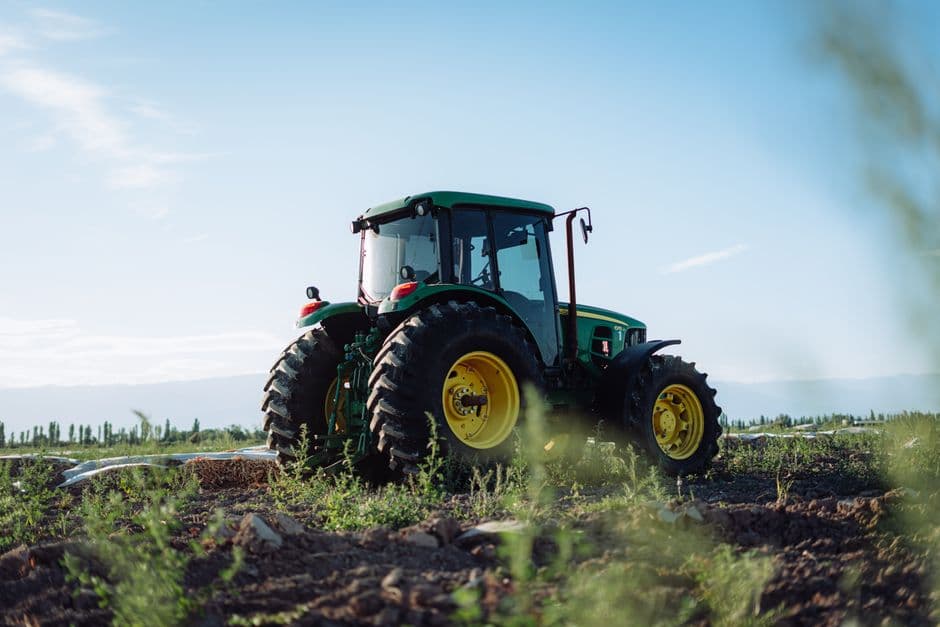
Ploughing and tillage: speed is the test
Pull depends on soil type, working depth, implement width and speed. You cannot change the soil, but you can see whether the match is right by watching the speed. The same extension guidance says a properly matched tractor and implement should work at 3 to 8 miles per hour, about 5 to 13 km/h:
- Below about 5 km/h, the tractor is undersized for the implement. It is overloaded, field capacity drops and wear rises.
- Above about 13 km/h, the tractor is oversized for the implement. Fuel per feddan is higher than it needs to be. The extension advice is to shift up a gear and throttle back on light work, while keeping the engine out of black smoke.
Iowa State University's field-capacity tables give typical working speeds and field efficiencies (the share of time actually spent working, after turns and stops):
| Implement | Typical speed | Field efficiency |
|---|---|---|
| Mouldboard plough | 8 km/h (5 mph) | 83 to 85% |
| Chisel plough | 9.7 km/h (6 mph) | 83 to 85% |
| Primary disc | 8 km/h (5 mph) | 80 to 83% |
| Secondary disc | 9.7 km/h (6 mph) | 80 to 83% |
| Field cultivator | 11.3 km/h (7 mph) | 78 to 85% |
Those speeds are for Iowa loams. Heavy Delta clay, wet or compacted, slows the work. Sandy reclaimed land in Nubaria or on the desert road pulls more easily but slips more, so traction rather than engine power often sets the limit. Iowa State's fuel estimates assume the tractor is ballasted to keep wheel slip below 15%; on sand, ask whether the tractor has ballast weights or filled tyres, and whether it is four-wheel drive.
How many feddans an hour
You can estimate a day's work before booking. In metric units:
Feddans per hour = width (m) × speed (km/h) × field efficiency ÷ 4.2
(A feddan is 4,200 m², and field efficiency is written as a decimal, so 85% is 0.85.)
Two examples:
- Three-furrow mouldboard plough, 35 cm per furrow (1.05 m wide), at a cautious 6 km/h in clay, field efficiency 0.85: 1.05 × 6 × 0.85 ÷ 4.2 = about 1.3 feddans an hour. Twenty feddans is roughly 16 field hours, or two full working days.
- Disc harrow 2 m wide at 8 km/h, field efficiency 0.80: 2 × 8 × 0.80 ÷ 4.2 = about 3 feddans an hour. The same 20 feddans takes under 7 hours.
Field hours exclude travel to the farm, hitching, refuelling and breakdowns, so add those when you plan days. If the tractor cannot hold the speed you assumed, the hours grow in proportion, which is the clearest sign of an undersized tractor.
Fuel per feddan
Iowa State also publishes the fuel used per area for common operations. Converted to litres, using the updated medians where they exist:
| Operation | Litres per hectare | Litres per feddan |
|---|---|---|
| Mouldboard plough | 13.1 | 5.5 |
| Chisel plough | 8.4 | 3.5 |
| Field cultivator | 5.6 | 2.4 |
| Tandem disc, tilled field | 5.1 | 2.2 |
| Mower | 2.8 | 1.2 |
Read these figures with their caveats. They were calculated for a central Iowa loam at about 18 cm ploughing depth, actual use can be 35% higher or lower depending on tractor and soil, heavier soils need more, and tractors built before 1990 or in poor repair may use 10% or more extra. As a planning figure, 20 feddans of mouldboard ploughing is around 110 litres of fuel before you adjust for clay and the tractor's age. Agree in advance who supplies and pays for the fuel; the general rules for fuel in rental quotes are covered in how equipment rental is quoted.
Land levelling
Laser levelling for surface irrigation uses a tractor pulling a scraper bucket whose blade is raised and lowered by a laser receiver. The tractor needs enough drawbar pull to move a full bucket of soil at a steady speed and enough hydraulic flow to respond to the laser quickly. Here, bucket width and how much soil must move matter more than the brochure horsepower. Ask the levelling contractor which bucket width they run and which tractor size they pair with it, and check that the tractor's hydraulic couplings match the bucket. Where new land needs heavy clearing, tracks or drains, that is earthworks rather than levelling; land levelling equipment covers when a dozer and grader take over.
Trailers
On a flat track, pulling a loaded trailer takes little power. Stopping it is the real limit. A heavy trailer without its own brakes pushes the tractor on a downhill canal bank, and that is how tractors jackknife or overturn. Check three things before loading:
- The permitted towed mass in the tractor's manual, which is usually lower for an unbraked trailer than for a braked one.
- The hitch rating and the drawbar pin.
- Whether the trailer brakes connect to the tractor.
Horsepower matters more for speed on slopes and long hauls. Safety comes from mass, brakes and hitch. For moving machines themselves between sites, see heavy equipment transport in Egypt.
PTO pumps
For a PTO-driven pump, the pump's own curve tells you the shaft power it needs at your flow and head, and its rated speed, usually 540 or 1,000 rpm at the PTO. As a cross-check, the power that goes into the water is:
Water power (kW) = flow (m³/h) × head (m) ÷ 367
A pump lifting 100 m³/h through 10 m of head puts about 2.7 kW into the water. The shaft needs more than that, depending on the pump's efficiency on its curve. Pumping runs for hours at a steady load, so choose a tractor that delivers the shaft power without running at full throttle the whole time, and confirm the PTO speed matches the pump.
What to send with a tractor request
- The job and the implement: number of furrows, width, and the PTO range on the implement plate.
- The area in feddans and the soil: clay, loam or sand, dry or wet.
- Whether you need the implement with the tractor, or bring your own.
- Whether you want an operator; the differences are explained in wet rental vs dry rental.
- Who supplies the fuel.
- The dates. Demand concentrates before planting, so book ahead of the autumn and spring windows.
- The farm location and access for delivery.
The short version
Ask which horsepower figure is quoted. Expect only 50% to 65% of PTO power at the drawbar. Use the implement's PTO range for spinning jobs and the 5 to 13 km/h speed check for pulling jobs. Estimate feddans per hour from width, speed and efficiency, and plan fuel per feddan with a wide margin for clay. For trailers, brakes and mass decide safety, not horsepower.
To compare tractors, browse tractor rental; the price comes in a written quote.
Sources and scope
Each source supports the topic described below, not every statement in this article. Foreign guidance does not replace Egyptian requirements or site rules. Use the manual matching the machine model and serial number for operation.
- Farm Energy (Extension Foundation) — Match implement size to tractor to save fuel (Grisso, Helsel, Grubinger)
Share of PTO power that reaches the drawbar in the field, and the field-speed range of a well-matched tractor and implement.
- Iowa State University Extension — Estimating the Field Capacity of Farm Machines (Ag Decision Maker A3-24, rev. Feb 2026)
Typical field speeds and field efficiencies per implement, and the field-capacity equations; Iowa conditions, ASABE-aligned medians.
- Iowa State University Extension — Fuel Required for Field Operations (Ag Decision Maker A3-27, rev. Feb 2026)
Approximate fuel per acre for tillage and field operations on a central Iowa loam, ±35% between tractors and soils; ballast for wheel slip below 15%.
Need a machine for your site?
Browse EXON's maintained fleet or talk to the team for a project quote.
Keep reading
Flatbed vs Lowbed Trailer, and Where the Tipper Fits: Which Trailer for Which Load
Flatbed vs lowbed trailer vs tipper: what each one carries, why deck height decides machine moves, how each is loaded, and what to tell the transporter before booking.
Mini Excavator for Villa Foundations and Utility Trenches: What It Can and Cannot Do
A mini excavator for villa foundations and service trenches: size classes, dig depth and width, gate and ground checks, buried services, and when you need a bigger machine.
Compressor CFM for a Jackhammer, Sandblasting or Spraying: The Numbers in Plain Terms
What compressor CFM a jackhammer, a sandblasting nozzle or a sprayer needs, in bar, l/s and m³/min, from manufacturer charts, plus the hose and nozzle traps.