Compressor CFM for a Jackhammer, Sandblasting or Spraying: The Numbers in Plain Terms
In this article
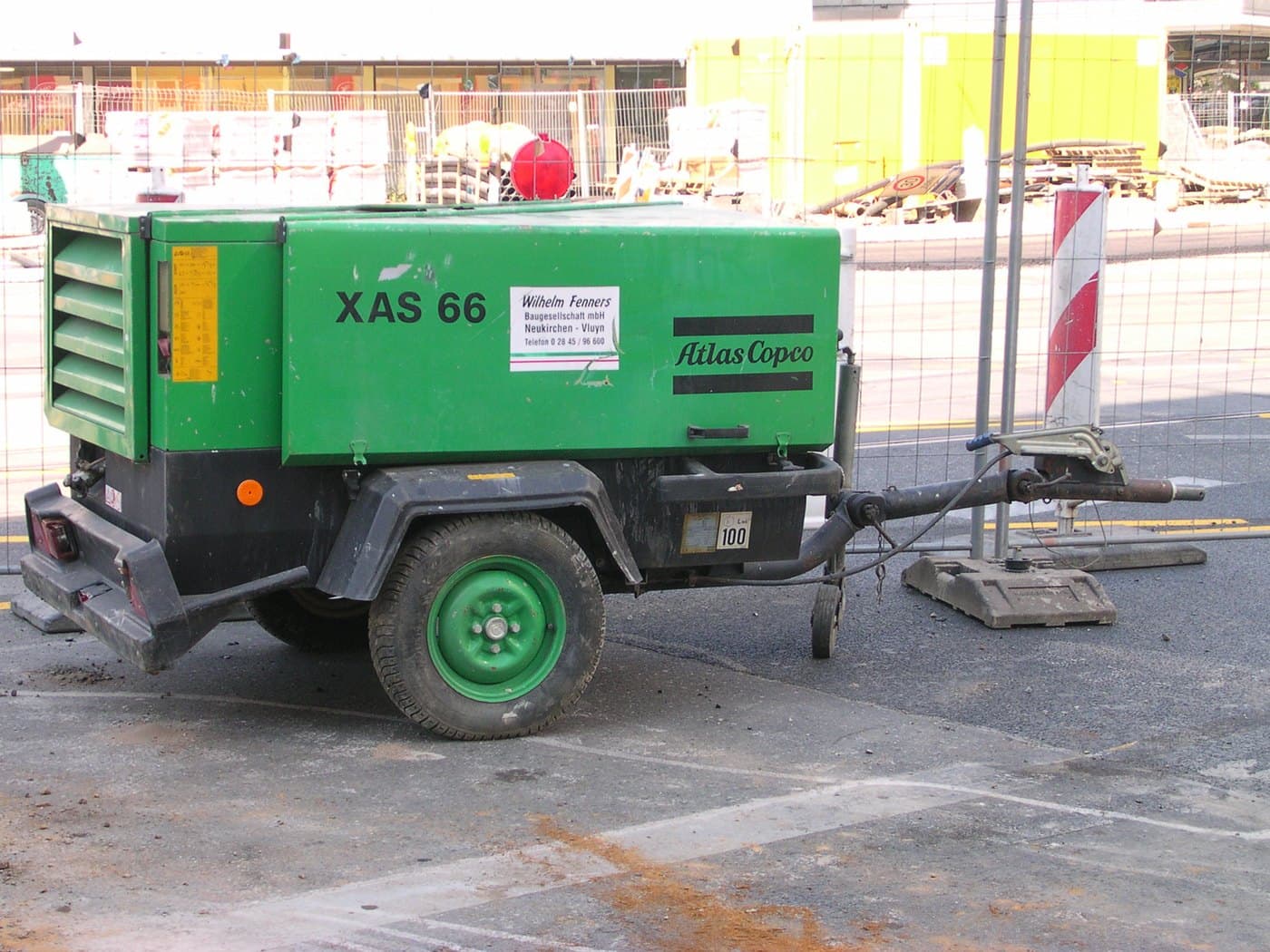
A site engineer phones a lessor and asks for "a compressor for two jackhammers and a bit of sandblasting". The lessor asks how big the blast nozzle is. Nobody on site knows. The answer decides whether the job needs a compressor that delivers about 3.5 cubic metres of air a minute or one that delivers closer to 9, and those are very different machines on very different trailers.
This guide answers the narrow question behind that call: what compressor CFM a jackhammer, a sandblasting nozzle or a sprayer actually needs, using the figures manufacturers publish. If you want the full method for sizing a compressor for a mixed tool list, with usage factors, heat and dust, read air compressor sizing for construction sites first. This post is the reference table you keep next to it.
CFM and bar in one paragraph
Every pneumatic tool needs two things at its inlet: pressure, measured in bar or psi, and flow, measured in cubic feet per minute (CFM), litres per second (l/s) or cubic metres per minute (m³/min). Pressure is how hard the air pushes. Flow is how much air arrives every minute to keep pushing. A compressor can show 7 bar on its gauge and still starve a breaker, because the gauge reads pressure with no flow going out. What matters is the flow the compressor holds at the pressure your tool needs, measured where the tool connects, not at the compressor outlet.
Egyptian quotes mix units, so keep the conversions at hand:
| Unit | Equals |
|---|---|
| 1 l/s | 2.12 CFM |
| 1 m³/min | 35.3 CFM, or 16.7 l/s |
| 6 bar | about 87 psi |
| 7 bar | about 100 psi |
Jackhammers and handheld breakers
Breakers are the easy case, because each model's air consumption is printed in its spec sheet. Atlas Copco publishes the following for its TEX range, and gives the TEX 230 PE's consumption at 6 bar:
| Breaker class | Weight | Air consumption |
|---|---|---|
| Light (TEX 150PE, 190PE, 21PE) | 19 to 22.5 kg | 25 to 26 l/s (53 to 55 CFM) |
| Medium (TEX 230PE, 280PE, 33PE, 60PS) | 25.5 to 33 kg | 30 to 36 l/s (63.5 to 76 CFM) |
| Heavy (TEX 37, 40PE, P90S) | 37 to 43 kg | 35 to 40 l/s (74 to 85 CFM) |
The same manufacturer's RTEX range lists a 25 kg breaker at 17.5 to 19 l/s. That is the first lesson: weight class does not tell you the air demand. Two 25 kg breakers can differ by more than a third. Ask for the model, then read its plate.
The arithmetic for breakers is simple:
- Take the consumption of each breaker that will run at the same time.
- Add them. Two TEX 230PE breakers need 2 × 30 = 60 l/s, which is about 127 CFM or 3.6 m³/min.
- Ask the lessor for a compressor that delivers more than that at the tool pressure, with headroom for hose losses, couplings and a compressor that is not new. Older compressors deliver less than their nameplate, and the gap grows quietly with wear and dirty filters.
Breakers also need clean, lubricated air. Most breaker manuals call for an oiler in the line, and a dry breaker wears fast. Confirm whether the lessor supplies the oiler, hoses and whip checks with the compressor.
If the demolition is heavy and continuous, compare the cost of a crew on handheld breakers with an excavator-mounted breaker; excavator with breaker hire covers when the switch pays.
Sandblasting: the nozzle decides everything
Sandblasting is where compressors are most often undersized, because the demand jumps sharply with nozzle size. Clemco's published consumption chart gives the air each nozzle uses at 7 bar (100 psi) measured at the nozzle:
| Nozzle | Orifice | Air at 7 bar | Metric |
|---|---|---|---|
| No. 4 | 1/4 in (6.5 mm) | 81 CFM | 2.27 m³/min |
| No. 5 | 5/16 in (8 mm) | 137 CFM | 3.84 m³/min |
| No. 6 | 3/8 in (9.5 mm) | 196 CFM | 5.50 m³/min |
| No. 7 | 7/16 in (11 mm) | 254 CFM | 7.11 m³/min |
| No. 8 | 1/2 in (12.5 mm) | 338 CFM | 9.46 m³/min |
Three things follow from that chart.
One No. 6 nozzle outdraws three TEX 230PE breakers. A blasting crew on steel structures can need more air than every other tool on site combined. If blasting is only a few weeks of the programme, a second compressor for those weeks is often cheaper than oversizing the main one for the whole project.
Nozzles wear, and worn nozzles eat air. A No. 6 nozzle that has worn out to 7/16 in behaves like a No. 7 and draws about 254 CFM instead of 196, so a compressor sized for the new nozzle falls behind. Check nozzle bores with a gauge and replace them on schedule, not when the crew complains.
Low pressure costs output. The same chart shows a 9.5 mm nozzle moving about 573 kg of abrasive an hour at 7 bar and about 435 kg at 5.6 bar. Pressure lost on the way to the nozzle shows up directly as slower blasting.
The nozzle figure covers the nozzle alone. A supplied-air helmet for the blaster, remote controls and any blow-off line need their own air, so ask for the figure for the complete blast system. Hose matters too: Clemco lists a minimum coupling bore of 38 mm (1-1/2 in) for a No. 6 nozzle and 50 mm (2 in) for Nos. 7 and 8. A narrower coupling anywhere in the line chokes the flow.
Finally, blasting needs dry air. Water in the line clumps abrasive and spoils the surface before coating, so an aftercooler and water separator belong in the quote whenever blasting or painting is in scope.
Spraying: paint, plaster and shotcrete are three different answers
"Spraying" covers jobs whose air demand ranges from nothing to more than a blasting rig.
Airless paint spraying needs no compressor. Graco explains that an airless sprayer pumps the paint through a spray tip at high pressure, 100 to 227 bar for traditional airless, and the stream breaks up into droplets on its own. Air-assisted airless runs the fluid at 35 to 100 bar and adds a little air at the gun. For large wall and steel coating on site, airless is the common choice, and the compressor question disappears for that crew.
Air spray guns, conventional or HVLP, do need air, and their consumption varies widely between guns. HVLP guns in particular use a large volume of air at low pressure at the cap. Read the figure on the gun's data sheet and size for it, with dry, oil-free air.
Shotcrete is in another league. The American Shotcrete Association's technical guidance gives these figures:
| Process | Air requirement | Air line |
|---|---|---|
| Dry-mix | 500 to 900 CFM (14 to 25 m³/min) at 100 to 125 psi | 38 to 50 mm (1.5 to 2 in) common |
| Wet-mix, robotic 64 to 75 mm nozzles | 600 CFM (17 m³/min) or more | 50 mm (2 in) and larger |
| Wet-mix, hand nozzle | Set by the nozzle maker | 19 mm (3/4 in) only on very short runs |
The same guidance warns that beyond roughly 30 to 45 metres, a 19 mm air line cannot feed most modern wet-mix hand nozzles; the fix is a 25 mm line or larger, or moving the compressor closer. It also flags a trap that applies to every air tool on site: imported couplings that look identical to full-flow couplings but have a narrow bore inside. One restrictive coupling can starve the whole line without any change in sound.
A worked example
A contractor refurbishing a factory in an industrial zone plans two medium breakers on floor slabs, a blaster with a No. 6 nozzle on steel columns, and airless painting after the blasting.
- Two breakers at about 30 l/s each: 60 l/s, about 127 CFM.
- One No. 6 nozzle at 7 bar: 196 CFM, plus the blaster's helmet air.
- Airless painting: no compressed air.
Running everything together needs well over 320 CFM before any margin. But the breakers work in the first weeks and the blasting comes later. Two right-sized hires in sequence, or one breaker compressor plus a short blasting hire, will usually beat one large compressor parked on site for the whole job. How lessors price short and long hires is covered in how equipment rental is quoted.
What to send with your request
To get the right compressor the first time, put these in the request:
- Every air tool, with model numbers where you have them.
- How many run at the same time, and for how many weeks.
- Blast nozzle size, and whether a supplied-air helmet is used.
- Hose length from compressor to the furthest tool, and the hose bore.
- Whether dry air is needed for blasting or painting.
- Who supplies hoses, couplings, oiler and whip checks.
- How the compressor is refuelled and who services filters on a dusty site.
The short version
Read the tool's consumption from its plate, add only what runs together, and size the compressor on flow at the pressure the tool needs. Breakers are tens of l/s each. Sandblasting is set by the nozzle and grows fast with every size and every millimetre of wear. Airless paint needs no compressor, while shotcrete needs the largest compressors on site. Then protect the flow with the right hose bore and full-flow couplings.
To compare portable compressors and their current rates, browse compressor rental.
Sources and scope
Each source supports the topic described below, not every statement in this article. Foreign guidance does not replace Egyptian requirements or site rules. Use the manual matching the machine model and serial number for operation.
- Atlas Copco — TEX pneumatic breakers
Published weight and air consumption (l/s, cfm) per TEX breaker model; check the plate of the exact tool.
- Clemco — Compressed-air and abrasive consumption chart
Air (cfm, m³/min) and abrasive use per blast nozzle size and nozzle pressure; nozzle air only, not the complete blast system.
- American Shotcrete Association — Common air system errors (Technical Tip, 2017)
Compressor capacity for dry-mix and wet-mix shotcrete, air-line diameter versus distance, and restrictive couplings.
- Graco — Intro to airless paint spraying
How airless and air-assisted airless sprayers atomise paint by fluid pressure, and their typical pressure ranges.
Need a machine for your site?
Browse EXON's maintained fleet or talk to the team for a project quote.
Keep reading
Scissor Lift Working Height and Platform Load: How to Size the Lift
Scissor lift working height vs platform height, platform load, indoor and outdoor ratings and floor loads: how to size a scissor lift for an Egyptian site.
Diesel vs Electric Forklift: Yards, Warehouses, Charging and Heat in Egypt
Diesel vs electric forklift in Egypt: fumes, floors, ramps, charging, double shifts and summer heat, and the questions that settle it before you rent.
How Wheel Loader Rental Is Priced in Egypt: Hour, Day, Month or Output
How a wheel loader rental price is worked out in Egypt: hourly, daily, the 208-hour month or by output, what moves the rate, and what to send for a quote.