Air Compressor Sizing for Construction Sites: Matching CFM to Your Tools
In this article
Two 30-kilogram breakers are working off one compressor on a demolition job. By mid-morning both tools are hitting the slab at visibly less energy than they had at eight o'clock. Nothing is broken. The compressor simply cannot deliver enough air for two breakers at once, so line pressure sags, every blow lands soft, and the crew burns a day doing three hours of work. The usual reaction is to blame the tools and send for a third breaker, which makes the problem worse.
Sizing an air compressor for a construction site is an arithmetic exercise, not a shopping decision. Get the numbers right at the quoting stage and the machine disappears into the background for the whole hire. Get them wrong and it quietly taxes every pneumatic tool on site for as long as it is there.
The two numbers on every compressor quote
Every compressor and every pneumatic tool is described by the same pair of values.
Pressure, in bar, is the force behind each blow or each rotation. Most construction air tools are designed around roughly 6 to 7 bar measured at the tool inlet — not at the compressor outlet, which is a distinction that costs sites a lot of productivity. This number stays fairly constant across a typical tool list.
Flow, quoted as free air delivery (FAD) in cubic feet per minute or litres per second, is how much air the machine can keep producing continuously. This is the number that varies enormously between machines and it is the one that determines whether your tools work properly. A compressor that reaches 7 bar with no tools connected tells you nothing; what matters is the pressure it holds while delivering the flow your tools are drawing.
So read the two together: a machine rated at a given FAD at a given working pressure. A flow figure quoted at a lower pressure than your tools need is not a figure you can use.
Start with the tool list, not the machine
The right way round is to write down every pneumatic tool that will be connected, then find the compressor. The figures below are indicative nameplate ranges to give you a sense of relative magnitude — always confirm against the plate on the actual tool, because two breakers of the same weight class from different manufacturers can differ substantially.
| Tool | Typical working pressure | Indicative air demand | Notes |
|---|---|---|---|
| Blow gun, tyre inflation, cleaning | 6–7 bar | Low, very intermittent | Rarely sizes anything, but adds up in a workshop |
| Needle scaler, light chipping hammer | 6–7 bar | Low | Concrete finishing, surface prep |
| Pneumatic concrete vibrator | 6–7 bar | Low to moderate | Often runs continuously during a pour |
| Handheld breaker, 20–30 kg class | 6–7 bar | Moderate to high | The workhorse on demolition and road works |
| Rock drill / jackleg | 6–7 bar | High | Continuous duty while drilling |
| Sandblasting pot | 6–7 bar and up | High to very high | Nozzle diameter drives everything; scales fast |
Two entries on that table deserve extra care. Sandblasting is the item that most often forces a jump to a much larger machine than the rest of the site needs — a steel-structure blasting package on an industrial job can out-demand every other tool combined, and nozzle wear increases consumption over the life of the nozzle. Rock drilling is the other: it is continuous rather than intermittent duty, so it does not benefit from the usage factor described below.
Add them up — but not all of them
The most common sizing error is summing every tool as if all of them run simultaneously at full duty. The second is sizing for one breaker because that is what the foreman mentioned on the phone.
The honest method sits in between:
- List every tool and its air demand at working pressure.
- Ask how many genuinely run at the same time. Two breakers on the same slab, yes. A breaker on the demolition face and a blow gun in the workshop, occasionally. Every tool in the container at once, no.
- Apply a usage factor to intermittent tools. A handheld breaker is not drawing air while the operator repositions, clears rubble, or waits for the loader. Over a shift, intermittent tools average well below their nameplate figure. Continuous-duty tools — drills, vibrators during a pour, blasting — do not get this discount.
- Have the supplier calculate the allowance for measured hose losses, simultaneous demand, tool wear and ambient conditions. There is no universal percentage that substitutes for tool and compressor data.
A worked shape rather than a fixed formula: if your peak realistic scenario is two breakers plus occasional cleaning air, size for the two breakers at full flow, add a small allowance for the third line, then add the margin. If a blasting pot is in scope for even one week of the programme, size the machine for the blasting and treat everything else as noise — or hire a second, smaller compressor for that week instead of oversizing for the whole project. The second option is usually cheaper, and the way rental terms are structured tends to reward it.
Hoses, whips and the pressure you lose on the way to the tool
This is where correctly sized compressors still fail in practice. Air loses pressure travelling down a hose, and the loss grows with length, shrinks dramatically with diameter, and rises with flow. A tool at the end of a long run of undersized hose is not receiving the pressure written on the compressor gauge.
Practical rules that hold up on site:
- Diameter beats everything. Going up one hose size does far more for delivered pressure than adding compressor capacity. Undersized hose is the single most common reason a properly specified machine underperforms.
- Keep runs short. Position the compressor as close to the work as noise, access and safety allow, rather than parking it at the gate and running eighty metres of hose.
- Do not daisy-chain tools off a single small line. Split from a manifold at the compressor, with a correctly sized line to each tool.
- Fix leaks the day you find them. A hissing coupling is a permanent tax on every tool on the network. Walk the line during a quiet period — you can hear leaks you cannot see.
- Fit whip checks across couplings. A hose that separates under pressure is a serious injury risk, and restraints are cheap.
Heat, dust and water: what Egyptian sites do to compressed air
Ambient conditions are not a footnote here. Compressor capacity is rated under reference conditions, and a machine working through a desert summer in Upper Egypt or on an open site around the New Administrative Capital is not operating under them.
- Heat. High ambient temperatures reduce the effective output of a diesel compressor and push cooling systems harder. Radiators and coolers must be kept clear, and the machine needs real airflow around it — not a tight gap between a container and a wall.
- Dust. Fine airborne dust and khamaseen conditions load air filters far faster than a temperate-climate service interval assumes. A blocked intake filter costs output before it causes any warning. Filter checks belong on the daily walk-round, alongside the same discipline you would apply to any machine on site.
- Water. Compressed air carries moisture that condenses as it cools in the hose. Water in the line degrades tool life, and it ruins blasting and paint work outright. Drain the receiver daily. If the work is surface preparation or coating, an aftercooler and a water separator are not optional extras — confirm them at the quoting stage.
Fuel burn is worth planning for too. A diesel compressor consumes at a rate driven by how hard it is loaded, so a machine running near capacity all shift burns considerably more than the same machine idling between bursts — the same load-versus-consumption relationship that applies to other diesel plant on site.
Diesel portable or electric on site power?
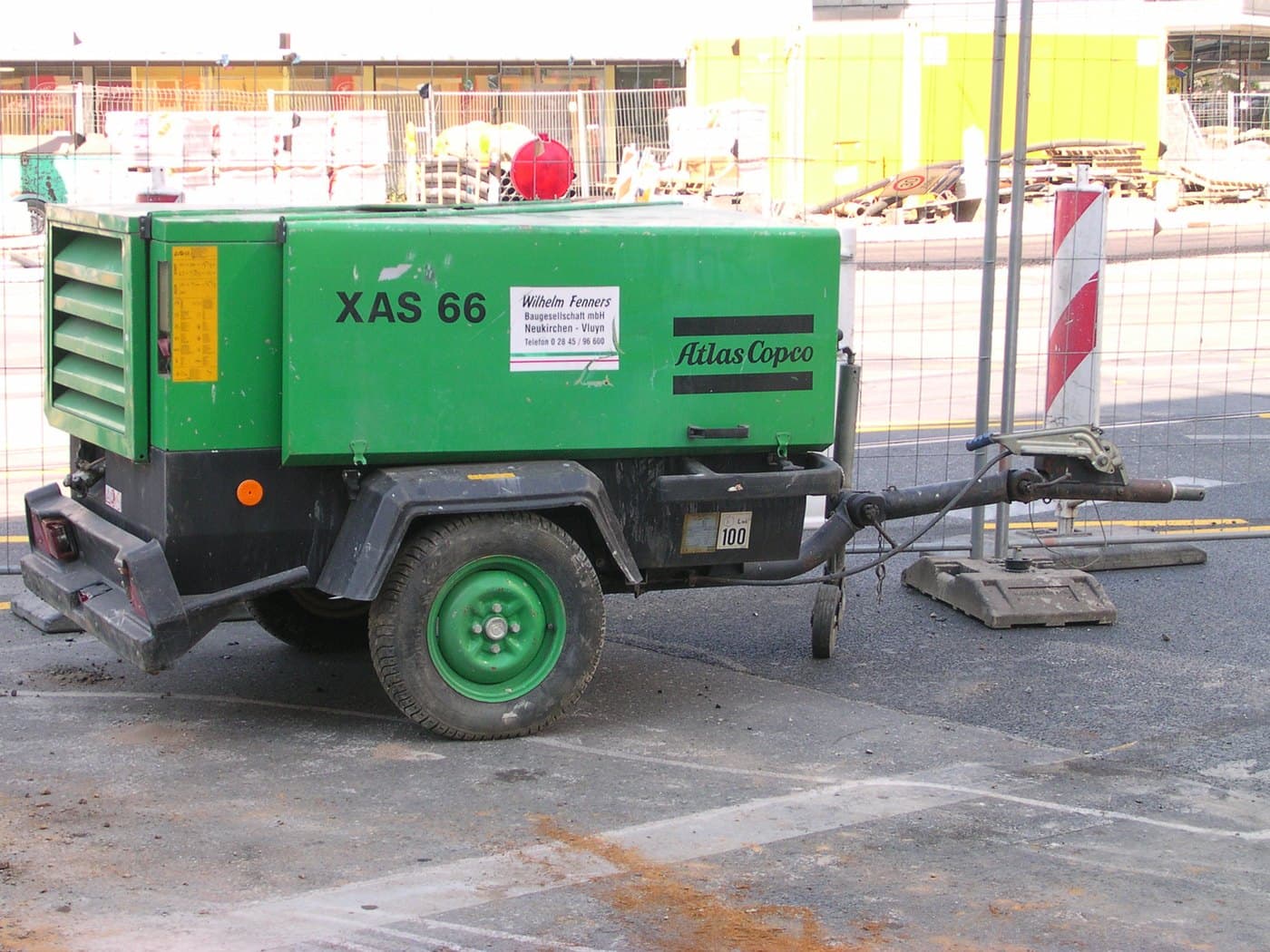
Portable diesel compressors dominate construction sites for the obvious reason: they are self-contained, they tow, and they work before permanent power exists. Electric units make sense in enclosed spaces, workshops, and where noise limits matter.
If you are considering an electric unit running off site power, size the generator for the compressor's starting characteristics rather than its running load — compressor motors draw a heavy inrush that has stalled more than one correctly sized generator. That interaction is worth working through carefully before committing to either machine; the approach to sizing site generators applies directly.
Most Egyptian sites end up with a towable diesel unit for the general tool load, and that is usually the right answer. You can browse available machines by class to see what the common portable sizes look like.
What to confirm before the compressor arrives
Rental practice varies between fleets, so ask rather than assume:
- Is the FAD figure quoted at your working pressure? Get both numbers on the quote.
- What is included? Hoses, couplings, whip checks, a lubricator, and the tools themselves may or may not be part of the package. Clarify each item.
- Who fuels it, and how is fuel billed? Conventions differ, and on a long hire the difference is significant.
- What is the service arrangement? Filters and oil on a dusty site need attention sooner than a standard interval implies. Establish who does it and how a breakdown is escalated.
- How is it positioned and secured? Level ground, clear airflow, safe distance from occupied spaces and openings, and a plan for exhaust and noise.
Getting it right the first time
The compressor is rarely the most expensive machine on a site, but an undersized one is among the most expensive mistakes available, because it degrades every tool connected to it and does so invisibly. Nobody logs a delay against "insufficient air"; it shows up as slow demolition, a missed pour, or a blasting crew standing around.
Write the tool list, be honest about what runs at the same time, respect hose sizing, and allow for heat and dust. If the scope is unusual — a heavy blasting package, a long tunnel of hose, or a mix of continuous and intermittent duty — set it out plainly when you request a project quote so the machine you receive is specified against the work rather than against a guess.
Sources and scope
Each source supports the topic described below, not every statement in this article. Foreign guidance does not replace Egyptian requirements or site rules. Use the manual matching the machine model and serial number for operation.
- Atlas Copco — Compressor sizing
Matching simultaneous flow demand and required tool pressure.
Need a machine for your site?
Browse EXON's maintained fleet or talk to the team for a project quote.
Keep reading
Flatbed vs Lowbed Trailer, and Where the Tipper Fits: Which Trailer for Which Load
Flatbed vs lowbed trailer vs tipper: what each one carries, why deck height decides machine moves, how each is loaded, and what to tell the transporter before booking.
Mini Excavator for Villa Foundations and Utility Trenches: What It Can and Cannot Do
A mini excavator for villa foundations and service trenches: size classes, dig depth and width, gate and ground checks, buried services, and when you need a bigger machine.
Tractor Horsepower for Farm Work: Sizing a Tractor for Ploughing, Levelling, Trailers and Pumps
What tractor horsepower farm work really needs: PTO vs drawbar power, field speed, feddans per hour and fuel per feddan for ploughing, levelling and pumps.