Scissor Lift vs Boom Lift: Choosing the Right Access Equipment for Your Site
In this article
A 12-metre scissor lift arrives at a warehouse in 6th of October to replace lighting over a racking run. The platform height is correct. The problem is that the fittings sit two metres inboard of an aisle the machine cannot enter, and a scissor lift travels straight up and nowhere else. The crew spends the morning shifting pallets to open an approach, and the day is billed for work that never happened. A boom lift with a few metres of horizontal outreach would have parked in the aisle and reached over the racking on the first attempt.
Choosing between a scissor lift and a boom lift is not a matter of preference or budget. It is a geometry problem with a short list of inputs, and most wasted access-equipment hires in Egypt trace back to one of those inputs never being checked before the machine left the yard.
The two families, and what actually separates them
Both are mobile elevating work platforms that put a guarded platform in the air so people can work with their hands free. The difference is the shape of the space each one can reach.
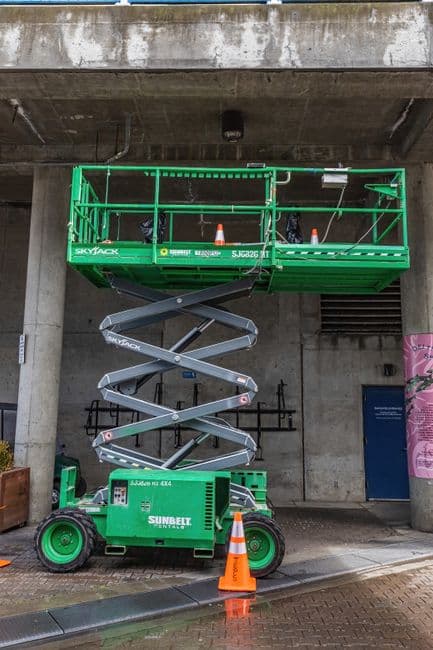
A scissor lift raises the platform vertically on a folding cross-brace. The platform sits directly over the chassis footprint and stays there. In exchange for having no reach at all, you get a large platform — often long enough for two or three workers plus materials — a high platform capacity for its size, and a compact machine that is easy to move and quick to set up.
A boom lift, called a cherry picker or simply a basket on most Egyptian sites, carries a smaller platform on a hinged or telescopic arm. It can place that platform up, out, over and sometimes down below the level it is standing on. The platform is usually smaller and rated for fewer people, and the machine is longer, heavier and more expensive to hire and to transport. What you are paying for is outreach.
Booms come in two families that behave very differently:
- Articulating (knuckle) booms fold at one or more joints. They are the tool for reaching over and around an obstruction — up past a canopy, over a pipe rack, into a bay whose entrance is blocked at low level.
- Telescopic (straight) booms extend in a line. They deliver the greatest horizontal reach and the greatest height for a given machine class, but they need a clear diagonal path from the chassis to the work.
Working height is not platform height
This single confusion causes more wrong-sized deliveries than anything else on the list.
Platform height is the height of the platform floor. Working height is a convention that adds roughly two metres to represent a standing person's reach. Some manufacturers and some quotes lead with one, some with the other, and the two are not interchangeable when you are trying to reach a specific soffit or fitting.
The safe method is to work in platform height only:
- Measure the height of the work itself — the underside of the slab, the fitting, the top of the steelwork.
- Subtract the comfortable reach of a person standing on the platform, which is less than you think once they are wearing gloves and holding a tool in both hands.
- Add clearance for whatever the platform must clear on the way up.
- Compare that number against the machine's platform height, and confirm which figure the quote is stating.
Never plan to stand on the midrail, on a bucket, or on a ladder inside the platform to close a gap. If the number is short, the machine is the wrong machine.
Outreach: the question that decides most jobs
Once the height works, ask a second question that people routinely skip: can the machine physically stand directly underneath the work?
If the answer is yes — an open slab, a clear warehouse floor, a car park deck — a scissor lift is almost always the cheaper, faster, more productive choice: bigger platform, more people working at once, less time repositioning.
If the answer is no, no amount of extra height fixes it. Something is in the way — a machine base, a landscaped strip, a live production line, a pipe rack, a canopy, an excavation. That is a boom lift job, and what you need from your rental provider is not just the height but the horizontal outreach at that height, because a boom's maximum reach and its maximum height are never available at the same time. Every boom has a working envelope, and the useful outreach shrinks as the platform goes up. Ask for the envelope, not a headline number.
Indoors or outdoors: the surface decides the machine
The second fork in the decision is ground.
Slab (electric) scissor lifts run on batteries with solid, non-marking tyres. They are quiet, produce no exhaust, turn tightly, and are built for a finished, level, load-bearing floor. They tolerate very little slope and almost no loose material. This is the machine for finishing works in a tower, a warehouse, a mall fit-out, a hotel atrium, a factory maintenance shutdown.
Rough-terrain scissor lifts are diesel, usually four-wheel drive, with large lugged tyres and often levelling outriggers. They will cross compacted ground, gravel and gentle slopes, and they lift more. They are the outdoor equivalent — cladding, external finishes, signage, façade access on an unfinished site.
Boom lifts exist in both electric-indoor and diesel rough-terrain forms, with a growing middle ground of bi-energy machines that run on battery indoors and a diesel engine outdoors. If your job crosses that boundary — starting on an external hardstanding and ending in a lobby — say so at the quoting stage. It is a specification, not a detail.
| If the job is… | Likely machine | Watch out for |
|---|---|---|
| Ceiling services, level indoor slab, work directly overhead | Electric slab scissor | Floor loading, door and lift dimensions |
| Two or three trades working together at height on an open floor | Scissor lift (platform size wins) | Platform capacity, not just height |
| Reaching over racking, plant, or a landscaped strip | Articulating boom | Outreach at the working height |
| Maximum reach across an open obstruction, façade or steelwork | Telescopic boom | Ground bearing, setup footprint |
| Compacted or uneven external ground | Rough-terrain scissor or diesel boom | Slope limits, tyre marking on finished surfaces |
| A single fitting, one worker, very tight indoor space | Compact/low-level machine | Do not oversize; access beats height |
The constraints people forget
Platform capacity. Every platform has a rated load covering people, tools and materials together. Two workers with a drill are one thing; two workers with a bundle of ductwork are another. Many machines also carry a lower rating when working outdoors, because wind acts on the platform and its load — check whether the quoted capacity is the indoor or outdoor figure.
Floor loading. A scissor lift concentrates several tonnes onto four small contact patches. On a suspended slab, a basement deck, a podium or over a service trench, that is a structural question, not a logistics one. Get the machine's weight and wheel loads before delivery and have them checked against the slab design. Spreader mats are a normal answer, not an admission of a problem.
Getting the machine to the work. More hires fail on this than on height. Measure the gate, the door, the ramp gradient, the turning circle at the corner, and the goods lift dimensions and capacity if the machine has to go up a building. A machine that is perfect for the work and cannot reach it is a machine you paid to store. Access machines also travel on flatbeds and need somewhere to land, turn and be driven off — the rules of moving heavy equipment between sites in Egypt apply here as much as they do to an excavator, and a boom lift's transport length surprises people.
Power and fumes. Diesel machines indoors are a ventilation problem before they are anything else. Electric machines need charging — realistically overnight, from a supply that exists and is available where the machine parks. Confirm the charging arrangement before the first shift, not during it.
If you are still weighing whether an access platform is the right family of machine at all, the comparison with telehandlers and forklifts is worth reading — they lift loads, not people. For heavier lifting, tower and mobile cranes start where access platforms stop. Once the specification is settled you can browse available machines by category.
Heat, dust and the Egyptian site
Local conditions change the calculation in ways the manufacturer's brochure does not mention.
Battery performance and charging both suffer in sustained summer heat, so an electric machine that comfortably lasts a full shift in mild weather may not in August — plan the charging window accordingly, and keep the machine out of direct sun when parked. Dust and fine sand load up radiators, filters and hydraulic seals on diesel machines faster than temperate-climate service intervals assume; on longer hires, agree who is checking what and how often.
Ground conditions on an active site rarely stay as they were on the day of the survey. Rubble, spoil and a new service trench routinely turn a viable slab-scissor plan into a rough-terrain job. Describing the ground honestly when you request the quote costs nothing; swapping the machine afterwards costs a day.
Night work is common on roads and in occupied buildings. If the platform will be working after dark, confirm the machine's own lighting and plan site lighting around it — a boom operator needs to see the envelope they are moving through, not just the work surface.
What to confirm before the machine ships
Across the Egyptian market, these are the questions worth asking any lessor before you agree a hire:
- The platform height and the outreach envelope, in writing, not the headline working height.
- The rated platform capacity, and whether it is the indoor or outdoor figure.
- Machine weight and wheel loads, if it is going onto any suspended structure.
- Transport dimensions and stowed length, so the delivery and the site access match.
- A current inspection or test certificate for the machine, kept in the site file.
- Operator competence: who is operating, and what familiarisation the lessor provides on delivery. Whether an operator comes with the machine is a commercial choice — the difference between wet and dry rental is worth settling early.
- Fall protection arrangements: guardrails are the primary protection on a scissor lift, while a full-body harness clipped to the platform anchor point is standard practice on any boom, because booms can catapult an occupant. Confirm the anchor points exist and that your crew has the equipment.
- Rescue plan: how a platform is brought down if the machine faults with someone at height, and who on site knows how to operate the ground controls.
The mistakes that repeat
Sizing on working height instead of platform height. Assuming a boom's maximum outreach is available at maximum height. Ordering an electric slab machine for ground that is not finished yet. Booking on height alone when the real constraint was platform capacity or a doorway. Discovering the goods lift cannot carry the machine on the morning of delivery.
Every one is answered by a site survey and a short conversation before the transporter is booked. With drawings and site photographs in hand, a rental provider can usually specify the machine correctly on the first pass — request a project quote with the height, the obstruction, the ground and the access dimensions, and the rest of the decision follows from there.
Sources and scope
Each source supports the topic described below, not every statement in this article. Foreign guidance does not replace Egyptian requirements or site rules. Use the manual matching the machine model and serial number for operation.
- Genie — Operator manuals
Model and serial-specific platform/telehandler operating limits.
- HSE — Planning lifting operations
Competent lift planning and supervision. UK guidance, not a statement of Egyptian law.
Need a machine for your site?
Browse EXON's maintained fleet or talk to the team for a project quote.
Keep reading
Flatbed vs Lowbed Trailer, and Where the Tipper Fits: Which Trailer for Which Load
Flatbed vs lowbed trailer vs tipper: what each one carries, why deck height decides machine moves, how each is loaded, and what to tell the transporter before booking.
Mini Excavator for Villa Foundations and Utility Trenches: What It Can and Cannot Do
A mini excavator for villa foundations and service trenches: size classes, dig depth and width, gate and ground checks, buried services, and when you need a bigger machine.
Tractor Horsepower for Farm Work: Sizing a Tractor for Ploughing, Levelling, Trailers and Pumps
What tractor horsepower farm work really needs: PTO vs drawbar power, field speed, feddans per hour and fuel per feddan for ploughing, levelling and pumps.