Wheel Loader vs Skid-Steer: How to Size a Loader for Your Site
In this article
A skid-steer loader spends a full shift at a villa compound in New Cairo pushing excavated spoil into tippers. The machine runs perfectly all day. It simply needs a dozen or more passes to fill each truck, so the tippers queue at the gate, the excavator upstream idles between loads, and a job that was priced on truck movements ends the day behind schedule. Twenty kilometres away, on a road widening, a large wheel loader is trying to work inside a service corridor it can barely turn in. Every bucket costs the operator a three-point turn against a kerb, and the machine's advantage — volume per pass — never appears.
Neither machine is faulty. Both are simply the wrong size for the work in front of them. Choosing between a wheel loader and a skid-steer, and choosing the right size within each family, is one of the few rental decisions on an Egyptian site that costs or saves money in every single hour of the hire.
Three loader families, not two
Egyptian sites use the word "loader" for machines that behave very differently.
Skid-steer loaders — what most yards and crews simply call a bobcat, after the brand that made the type common — are compact, rigid-frame machines that steer by driving the wheels on one side faster than the other. They are small enough to work inside a building shell, cheap to transport, and accept a very wide range of attachments. Their bucket is small, their reach is short, and their pushing power into a tight pile is limited by weight. The tracked version, a compact track loader, trades some speed for far better flotation on soft or sandy ground.
Compact and mini wheel loaders are articulated machines — they bend in the middle instead of skidding — with a bucket meaningfully larger than a skid-steer's and a much gentler footprint on finished surfaces. They turn without scrubbing the ground, which matters on interlock, on a finished slab, and on landscaped areas. They are the natural machine for backfilling, for feeding a small batching plant, for yard and warehouse handling, and for stockpile work where the pile is not enormous.
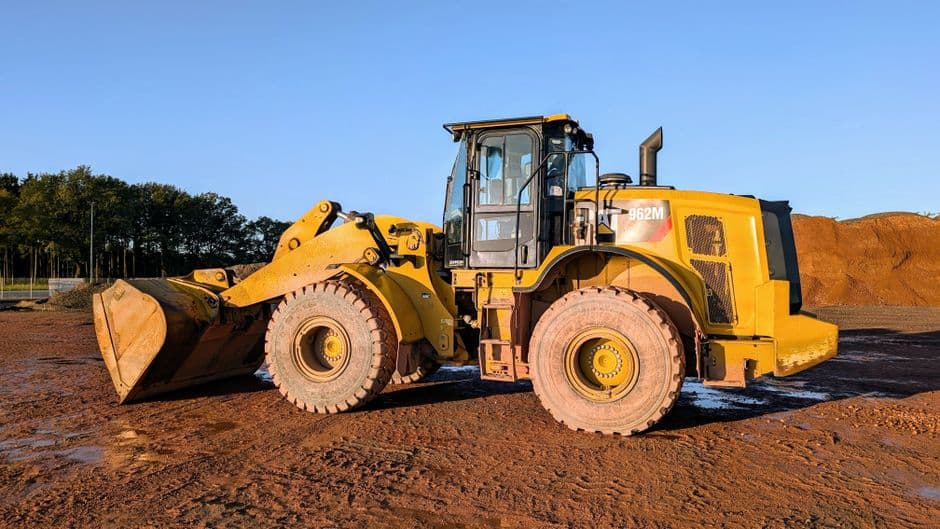
Wheel loaders proper are the yellow articulated machines built to fill trucks. Bucket capacity climbs with operating weight, and so does breakout force, lift height and dump clearance. Above a certain size they are quarry and bulk-materials tools: their whole economic argument is that they empty a stockpile into a truck in very few passes.
| Skid-steer / track loader | Compact wheel loader | Wheel loader | |
|---|---|---|---|
| Typical work | Confined sites, finishing, clearing, attachment work | Backfill, yard handling, small stockpiles | Truck loading, bulk materials, aggregate |
| Turning | Skids on the spot | Articulated, gentle on surfaces | Articulated, needs a swing radius |
| Ground | Tracks needed for soft sand | Good on compacted ground | Good on compacted ground and haul roads |
| Transport | Light — often a flatbed or small trailer | Moderate | Heavy — proper lowbed and route planning |
| Bought for | Versatility and access | Balance | Volume per pass |
Start with the material, not the bucket
The first mistake in loader sizing is quoting a bucket in cubic metres and stopping there. A bucket is a volume; what the machine actually lifts is a weight, and the same bucket holds very different weights depending on what is in it.
Loose sand and gravel are conventionally taken at somewhere around 1.5 to 1.7 tonnes per cubic metre — but confirm that against the material you actually have, because moisture alone moves the number. Wet sand after a canal-side excavation is heavier than the dry sand from the same borrow pit. Crushed stone is heavier again. Demolition rubble is heavier still and does not flow into the bucket the way a graded material does. Topsoil, wood waste and light debris sit at the other end and will let a machine carry a heaping bucket without noticing it.
Three practical consequences:
- A loader's rated operating capacity and its tipping load are the limits that matter, not the bucket's cubic-metre figure. Ask for both.
- With heavy material you specify a smaller bucket on the same machine, not a bigger one. A large bucket on a light machine is unsafe and slow, because the operator can never fill it.
- With light material — topsoil, agricultural waste, insulation, packaging — an oversized light-material bucket on the same carrier is the productivity gain, and it costs nothing extra in machine class.
Match the loader to the truck, not to the pile
The single most useful rule in loader selection has nothing to do with the loader. It is the relationship between the loader's bucket and the body of the truck being filled.
A well-matched pair fills a truck in roughly four to six passes. Fewer than that and the loader is too large for the truck: you spill material, you shock the truck's suspension, and you are paying for a machine class you cannot use. Many more than that and the loader is too small: cycle time per truck balloons, the truck's waiting time becomes the constraint on the whole earthworks operation, and you are effectively paying a truck fleet to watch a small machine work.
So before you ask for a loader, answer these:
- What size of truck is coming to the site — a small tipper, a standard 6-wheeler, a large tipper, or an articulated hauler?
- How many trucks per hour does the programme need?
- Is the loader also the machine that keeps the stockpile tidy, or is that someone else's job?
If the trucks are large and the volumes are real, a small machine will not catch up by working longer hours. This is the same arithmetic that drives what an excavator hire actually costs: the machine is rarely the expensive part of an earthworks day — waiting is.
Ground conditions decide tyres or tracks
Egypt gives you two very different loader environments, sometimes on the same project.
On compacted ground, haul roads, and finished areas, wheels win comfortably. They are faster between the pile and the truck, they consume less fuel per tonne moved, they cost less to hire, and tyre wear is predictable if the operator is not spinning against the pile.
On soft sand, fresh fill, and unconsolidated desert ground — the reality on a great many compounds and new-city plots before roads go in — a wheeled machine sinks, spins, and burns fuel doing neither work nor damage in useful proportions. This is where a compact track loader earns its higher hire rate: ground pressure spread over a track keeps it on top of material a wheeled machine ploughs into.
Two related points that get overlooked at the quoting stage:
- Tyre specification matters. Loose abrasive material and demolition debris chew ordinary tyres. Ask what is fitted and whether the material you are handling is appropriate for it, because tyre damage is frequently a chargeable item in Egyptian rental terms.
- Site cleanliness is a cost. A machine that runs in loose fines all day needs its radiator pack blown out far more often than one on a clean slab, and thermal problems in Egyptian summer heat are the fastest route to a stopped machine.
Access, footprint, and the gate test
Before the size question is settled, walk the route the machine will actually take.
- The gate and the ramp. Overall width, overall height with the boom lowered, and the approach angle onto a ramp or a basement slope are the three dimensions that stop deliveries. Measure them; do not estimate.
- The working radius. An articulated loader needs room to swing its rear end. In a corridor between a building line and a boundary wall, a machine that is theoretically the right capacity may be unable to complete a cycle without reversing twice, which erases its advantage.
- The overhead. Dump clearance and dump reach decide whether the machine can put material over the side of the truck body at all. A loader that must edge forward and lift to its absolute limit at every pass is slow and hard on the operator.
- The floor. On a finished slab, in a basement, or inside a warehouse, ask about exhaust and about surface marking. Skid-steers scuff by design when they turn.
Transport is part of this decision, not a follow-on from it. A skid-steer can travel on a modest trailer; a large wheel loader is a lowbed movement with its own planning and its own timing. That is covered in more detail in the guide to moving heavy equipment between sites in Egypt, and it is worth reading before you assume a bigger machine is a free upgrade.
Attachments change the economics
The reason skid-steers persist on sites that could justify something bigger is the attachment interface. A single carrier with a quick coupler can, across one project, run a bucket, forks, a sweeper, a breaker, an auger, a trencher, a grapple and a mixing bowl.
Where that matters:
- Finishing and fit-out phases, when the earthworks fleet has gone and the site still needs daily material handling.
- Facilities and yards, where the same machine sweeps in the morning and handles pallets in the afternoon.
- Light demolition and strip-out, where a breaker on a small carrier can work inside a structure that no large machine can enter.
If your work is mostly handling palletised material at height rather than at ground level, the comparison you actually want is telehandler versus forklift, not loader versus loader. Loaders are for bulk material; the fact that a bucket can shove a pallet does not make it the right tool.
For anything with sustained bulk volume, size the machine for the trucks and accept that a second, smaller carrier for odd jobs is usually cheaper than compromising both roles into one machine. It is worth browsing the available loader classes with the truck size and material in hand rather than the other way round.
What to confirm before the machine is loaded
Whichever way the decision goes, get these in writing at the quoting stage. Every one of them is a normal question in the Egyptian market and none should cause friction with a serious lessor.
- Operating weight, rated operating capacity, and bucket capacity — all three, not whichever number the machine is marketed on.
- Bucket type supplied, and whether an alternative (general purpose, light material, rock, 4-in-1) is available.
- Tyres or tracks, their condition, and who carries the cost of damage from the material being handled.
- Attachment coupler type if you intend to run anything other than the supplied bucket, and whether the auxiliary hydraulics are single or double acting.
- Delivery dimensions and weight for your gate, your ramp and your route.
- Who fuels the machine, and at what consumption assumption — consumption per hour is a real cost line, discussed in the guide to diesel burn on heavy machines.
- What happens on a breakdown day, and how downtime is treated on the invoice.
Most fleets in Egypt will discuss all of this openly before a machine is dispatched, and it is common for lessors to recommend a different size than the one first requested once they hear the truck size and the material. That conversation is worth having. If you have the material, the truck and the access dimensions ready, you can request a project quote and get a specification back rather than a price for a guess.
The short version: decide the material and the truck first, the ground second, and the access third. The loader size falls out of those three answers almost on its own — and a machine chosen that way rarely spends its hire spinning, queuing, or reversing.
Sources and scope
Each source supports the topic described below, not every statement in this article. Foreign guidance does not replace Egyptian requirements or site rules. Use the manual matching the machine model and serial number for operation.
- Caterpillar — Excavator maintenance checklist
Walkaround checks and the model operation and maintenance manual.
- HSE — Loading and unloading
Safe loading/unloading arrangements. Route permits need local confirmation.
Need a machine for your site?
Browse EXON's maintained fleet or talk to the team for a project quote.
Keep reading
Flatbed vs Lowbed Trailer, and Where the Tipper Fits: Which Trailer for Which Load
Flatbed vs lowbed trailer vs tipper: what each one carries, why deck height decides machine moves, how each is loaded, and what to tell the transporter before booking.
Mini Excavator for Villa Foundations and Utility Trenches: What It Can and Cannot Do
A mini excavator for villa foundations and service trenches: size classes, dig depth and width, gate and ground checks, buried services, and when you need a bigger machine.
Tractor Horsepower for Farm Work: Sizing a Tractor for Ploughing, Levelling, Trailers and Pumps
What tractor horsepower farm work really needs: PTO vs drawbar power, field speed, feddans per hour and fuel per feddan for ploughing, levelling and pumps.