Diesel vs Electric Forklift: Yards, Warehouses, Charging and Heat in Egypt
In this article
A typical case: a ceramics distributor rents a 3-tonne diesel forklift to work inside a closed store in an industrial zone. It lifts everything it is asked to. Two weeks later the storekeepers are complaining of headaches, the white walls near the racking have gone grey, and the manager asks for an electric truck instead. The electric one arrives, and nobody has checked where the charger will be plugged in.
The diesel vs electric forklift question is rarely about which machine is "better". Both lift the same pallet. It is settled by five things about your site: the air, the floor, the power supply, the shift pattern and the heat. This guide goes through each one, then gives the questions that settle it before the truck is booked. Capacity, load centre, mast height and tyres are covered in how to choose a forklift for rental; this post is only about the power source.
The quick answer
| Where the forklift works | Usually the right choice | Why |
|---|---|---|
| Closed warehouse, low ventilation | Electric | No exhaust inside the building |
| Food, pharma or packaging plant | Electric | Exhaust and soot are not acceptable near product |
| Open yard: sand, interlock, potholes | Diesel | Ground clearance, pneumatic tyres, no charging point needed |
| Building-materials store with open sides | Diesel, or electric on a good slab | Depends on the floor and how much time is spent indoors |
| Container unloading from outside into a store | Depends on the time inside | Short runs in with doors open can suit diesel; long runs inside suit electric |
| Two or three shifts a day | Diesel, unless a spare battery or fast charging is arranged | Refuelling takes minutes; a battery takes hours |
| Site with no reliable electricity | Diesel | An electric truck is only as reliable as its charger's supply |
The rest of this post explains the reasoning behind each row, because most real sites sit between two of them.
Air: the reason electric exists
A diesel forklift burns fuel a few metres from the people working beside it. Outdoors the exhaust disperses; inside a closed store it builds up. The UK Health and Safety Executive's guidance on diesel engine exhaust lists what employers should consider where exposure cannot be avoided: extraction fans, tailpipe extraction and filters, turning engines off when not needed, and keeping doors open. It also gives a simple sign that fumes are not controlled: soot on walls and surfaces. That is UK guidance, not Egyptian law, but the physics is the same in an Obour warehouse.
In practice this means:
- Occasional trips inside (a diesel truck carrying pallets a few metres through a wide open door) are common and manageable with the doors open and the engine off whenever the truck is waiting.
- A diesel truck working a full shift inside a closed building is the case that goes wrong. Ventilation that seems fine in the morning is not fine after six hours.
- Food, pharma, textiles and anything packed for export usually rule out diesel indoors entirely, often in the customer's own audit requirements.
An electric truck produces no exhaust at all, which is why it is the default inside buildings.
Floor and ground: where electric trucks struggle
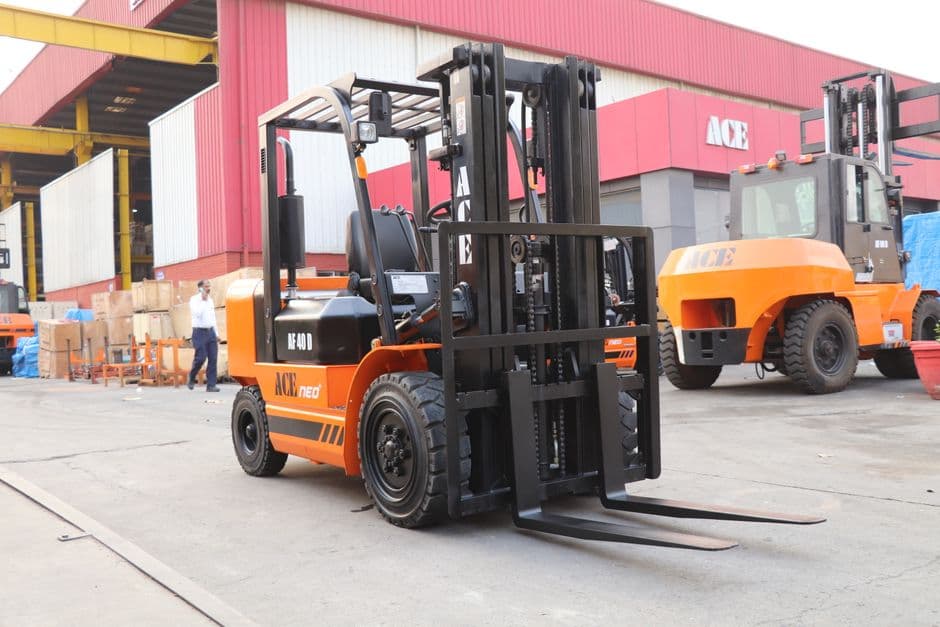
Most electric counterbalance forklifts are built for warehouse floors: smooth concrete, small wheels, cushion or solid tyres, and low ground clearance. They turn tightly and ride well on a trowelled slab. Put the same truck on compacted sand, broken interlock or a yard with potholes and rebar offcuts, and it struggles, gets stuck or damages its underside.
Diesel trucks are more commonly specified with pneumatic or solid pneumatic tyres and more ground clearance, which is why they dominate open yards, building-materials stores and ports. If the ground is unpaved, the choice is usually made before fumes or charging are even discussed.
Ramps matter for both. A ramp into a basement store or up to a loading dock has to be climbed loaded. Ask for the truck's gradeability with a rated load from its spec sheet and compare it with your steepest ramp, rather than assuming either power type copes.
Charging: the question that gets forgotten
Renting an electric forklift means renting its charging arrangement too. Before booking, the site needs answers to four questions.
- Where is the charger, and what supply does it need? Industrial chargers for forklift batteries often need a three-phase supply. Check the charger's rating plate against what the building has, before the truck arrives, not after.
- Where does the truck charge? Lead-acid batteries give off hydrogen while charging, so the charging area needs ventilation, no smoking or hot work nearby, and space away from stored goods. Most warehouses set aside a corner near an opening.
- How long does it take? A common rule of thumb for lead-acid batteries is a full shift of work, a long charge, then time to cool before the next shift; the manufacturer's manual gives the actual figures for that battery. Lithium-ion batteries can take short top-up charges during breaks, but they are less common in the rental market.
- What happens in a power cut? A truck that ends the shift flat and loses its overnight charge to a cut starts the next day at half a battery. Sites with unreliable supply either charge from a generator, sized for the charger's input, as covered in setting up a site generator, or choose diesel.
The electric truck's data plate also matters here: the rated capacity assumes the battery the truck was built for. A smaller or lighter replacement battery changes the counterweight, so ask for the plate and the battery fitted to match. The OSHA nameplate guidance explains what the plate should show.
Shifts: one battery, one shift
The shift pattern often decides the question on its own.
- Single day shift: electric works well. The truck charges overnight and starts each morning full.
- Two shifts: electric needs either a second battery with a way to change it safely, a lithium battery that takes top-up charges during breaks, or a second truck. Without one of these, the second shift runs on a half-empty battery.
- Round the clock: diesel is simpler. Refuelling takes a few minutes and the truck is back at work.
Ask the lessor how the truck will be charged across your shift pattern, not just whether it is electric.
Heat: the Egyptian summer is hard on both
Heat affects both types, in different ways.
Batteries age faster when they run and charge hot. A charging corner under a tin roof in August, with no airflow, shortens a battery's life and can trip the charger. Put the charger where air moves, out of direct sun.
Diesel engines run hot in yards where dust clogs the radiator. A daily blow-out of the radiator and a check of the coolant level matter more in July than in January. The daily walkaround is the same one described in the daily inspection checklist.
Operators feel the heat first. An open truck working in the sun in Upper Egypt in August needs at least a canopy for shade, whatever powers it.
Running costs: what to compare
Without quoting prices, which change month to month, the cost comparison comes down to three lines:
- Energy per shift: fuel for the diesel truck, electricity for the charger. In dry hire, both are usually paid by the hirer, so ask how many litres or kilowatt-hours a shift uses on similar work and price it yourself.
- Downtime: an electric truck has fewer engine parts to service, but a failed charger or a dead battery stops it just as surely as a broken injector stops a diesel.
- Losses: damaged goods from fumes, a failed customer audit, or a truck stuck in a sandy yard cost more than any difference in the energy bill.
Who pays for fuel or electricity, and what counts as downtime, should be written in the contract, as discussed in the equipment rental contract in Egypt.
What about LPG?
LPG forklifts sit between the two: cleaner exhaust than diesel, refuelled by swapping a cylinder, and usable in well-ventilated buildings. They still produce exhaust, and they depend on a dependable cylinder supply near the site. Where that supply exists, LPG can suit a store that is part yard and part warehouse.
Availability in the market
Forklifts are among the easiest machines to source in Egypt. In the public Facebook equipment groups tracked by the EXON Radar, forklifts drew about 2 requests for every 100 listings, against 33 for dump trucks, as of 23 September 2026 (see demand pressure). TCM is the most-listed forklift brand, at 43% of branded forklift listings on the same date (see brands). Those are listing counts, not a split of diesel and electric units, so ask the lessor directly which power types they have and whether the electric trucks come with their chargers.
Questions that settle it
- How many hours a day will the truck spend inside a closed building?
- Is the floor a trowelled slab, rough concrete, interlock, or sand?
- What is the steepest ramp, and what is the heaviest load that climbs it?
- How many shifts a day, and how many days a week?
- Is there a suitable supply for a charger, and a ventilated place to put it?
- How reliable is the electricity, and is there a generator?
- Does any customer or product rule out exhaust?
If the answers point inside, onto smooth floors, with one shift and a steady supply, choose electric. If they point outside, onto rough ground, with long shifts or weak power, choose diesel. If they point both ways, the time spent indoors usually decides it.
The short version
Choose electric for closed buildings, clean products and smooth floors, and plan the charger, supply and ventilation before the truck arrives. Choose diesel for yards, rough ground, long shifts and sites without reliable power, and keep it out of closed buildings for long periods. Check the heat plan for both.
To compare the forklifts available and their current rates, browse forklift rental.
Sources and scope
Each source supports the topic described below, not every statement in this article. Foreign guidance does not replace Egyptian requirements or site rules. Use the manual matching the machine model and serial number for operation.
- HSE — Diesel engine exhaust emissions
Exposure controls for diesel exhaust indoors: extraction, ventilation, engines off when idle. UK guidance, not Egyptian law.
- OSHA — Forklift nameplate
Capacity, load centre and configuration on the data plate. US guidance, not Egyptian law.
- EXON Radar — Egypt heavy-equipment market analytics
Aggregate counts from public Facebook equipment groups, snapshot dated 23 Sep 2026; asking prices, not sale prices.
Need a machine for your site?
Browse EXON's maintained fleet or talk to the team for a project quote.
Keep reading
How Wheel Loader Rental Is Priced in Egypt: Hour, Day, Month or Output
How a wheel loader rental price is worked out in Egypt: hourly, daily, the 208-hour month or by output, what moves the rate, and what to send for a quote.
How to Choose a Crane for Your Lift: Type and Tonnage Before You Book
How to choose a crane for a lift in Egypt: work out the tonnage from weight, radius and height, pick the crane type, and know what to send before booking.
Site Generator Setup: Prime vs Standby, Silent Units, Fuel and Connection
Setting up a site generator in Egypt: prime vs standby rating, silent units near homes, fuel records, cables, earthing and ATS, and what to settle first.